Javis603/token-monitor
Local-first desktop widget for tracking token usage, costs, limits, and session activity across 47+ AI coding tools—including Claude Code, Codex, Cursor, OpenCode, OpenClaw, and more—with multi-device sync.
Token Monitor is a desktop app for viewing live token usage and AI tool limits across 47+ AI coding tools, including Claude Code, Codex, and Hermes Agent. It offers multi-device sync, historical usage trends, and breakdowns by tool, device, model, session, or project, with views in its main window, MacBook notch, menu bar or system tray, screen edge, floating bubble, and native macOS widgets.
- Shows token usage and tool limits across 47+ AI coding tools.
- Provides multi-device sync and historical usage trends.
- Breaks usage down by tool, device, model, session, or project.
full readme from github

Token Monitor
One live dashboard for every AI coding tool, synced across every machine.






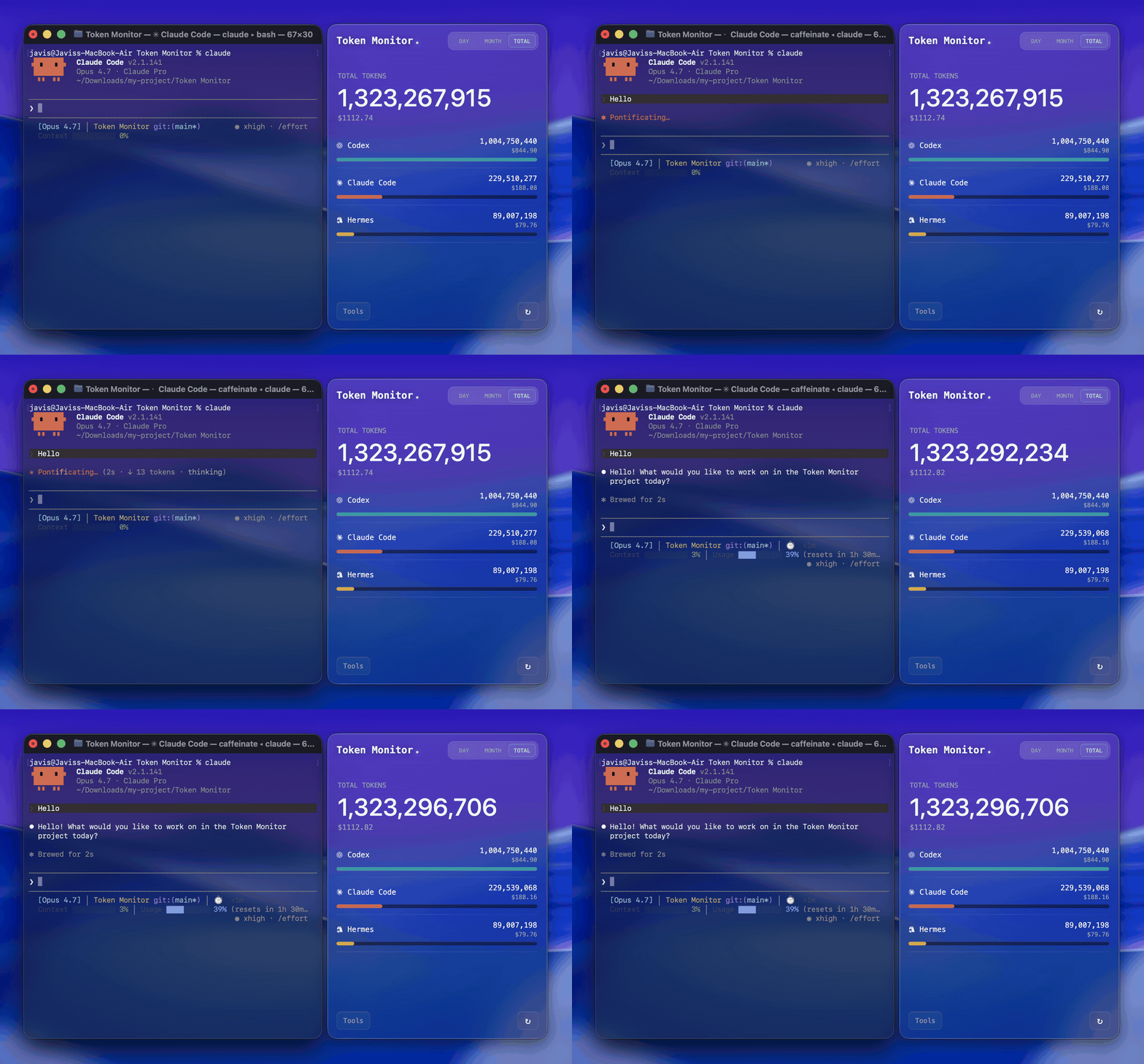
What is Token Monitor?
A desktop app that shows live token usage and AI Tool Limits across 47+ AI coding tools — Claude Code, Codex, Cursor, GitHub Copilot, Cherry Studio, and more — with real-time multi-device sync, historical usage trends, and breakdowns by tool, device, model, session, or project. It lives wherever you look: the main window, the MacBook notch, the menu bar or system tray, the edge of the screen, a floating bubble, and native macOS widgets.
Supported Tools
Token usage, AI Tool Limits and session details from the AI coding tools and providers you already use:



































See what each tool supports and where its data is read from →
Showcase
On your desktop
 Notch Panel — running sessions beside the notch; swipe down for today's usage, every account's limits, sessions and breakdowns |
|
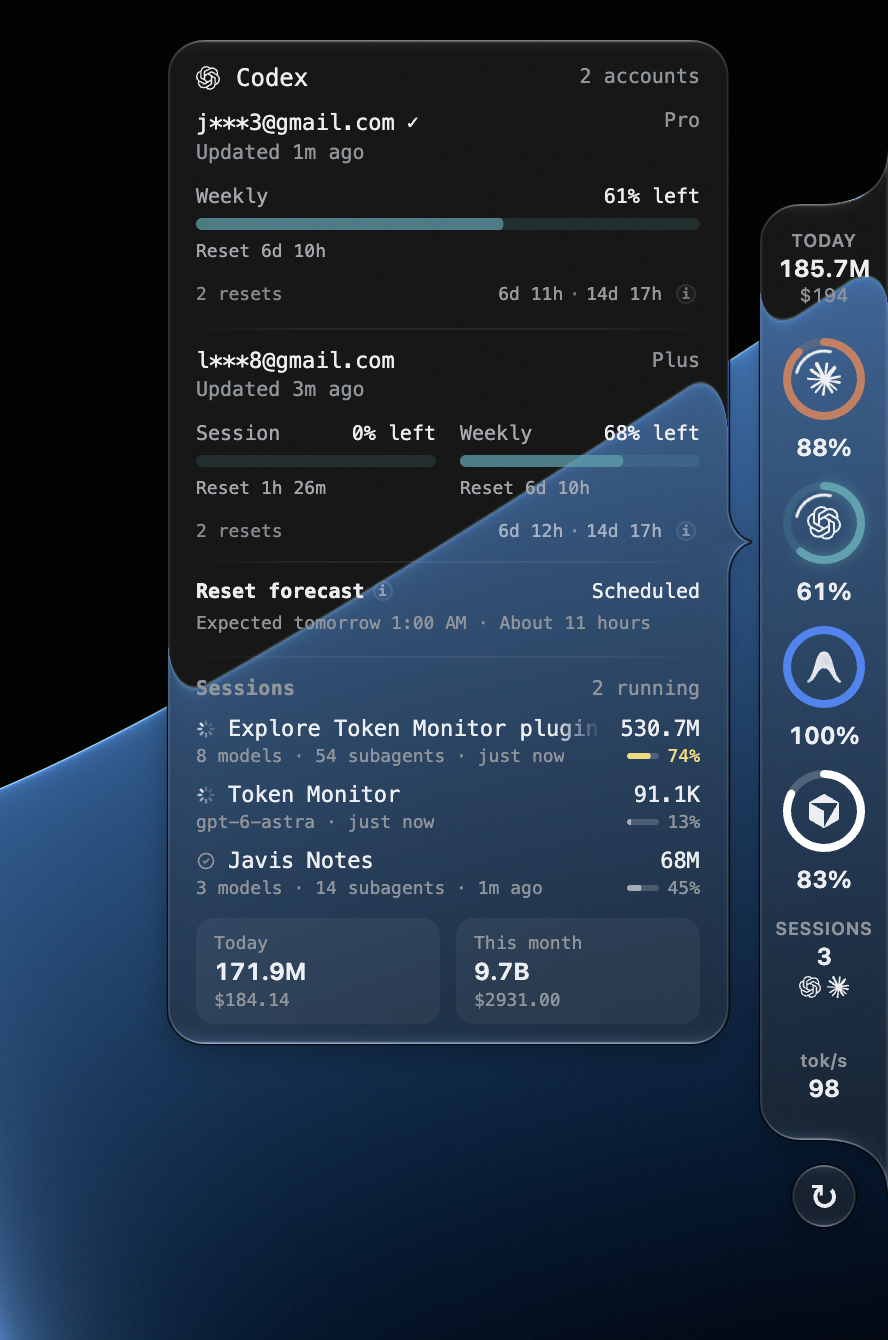 Edge Dock — quotas and usage parked at the screen edge; hover for limits, recent sessions and tokens |
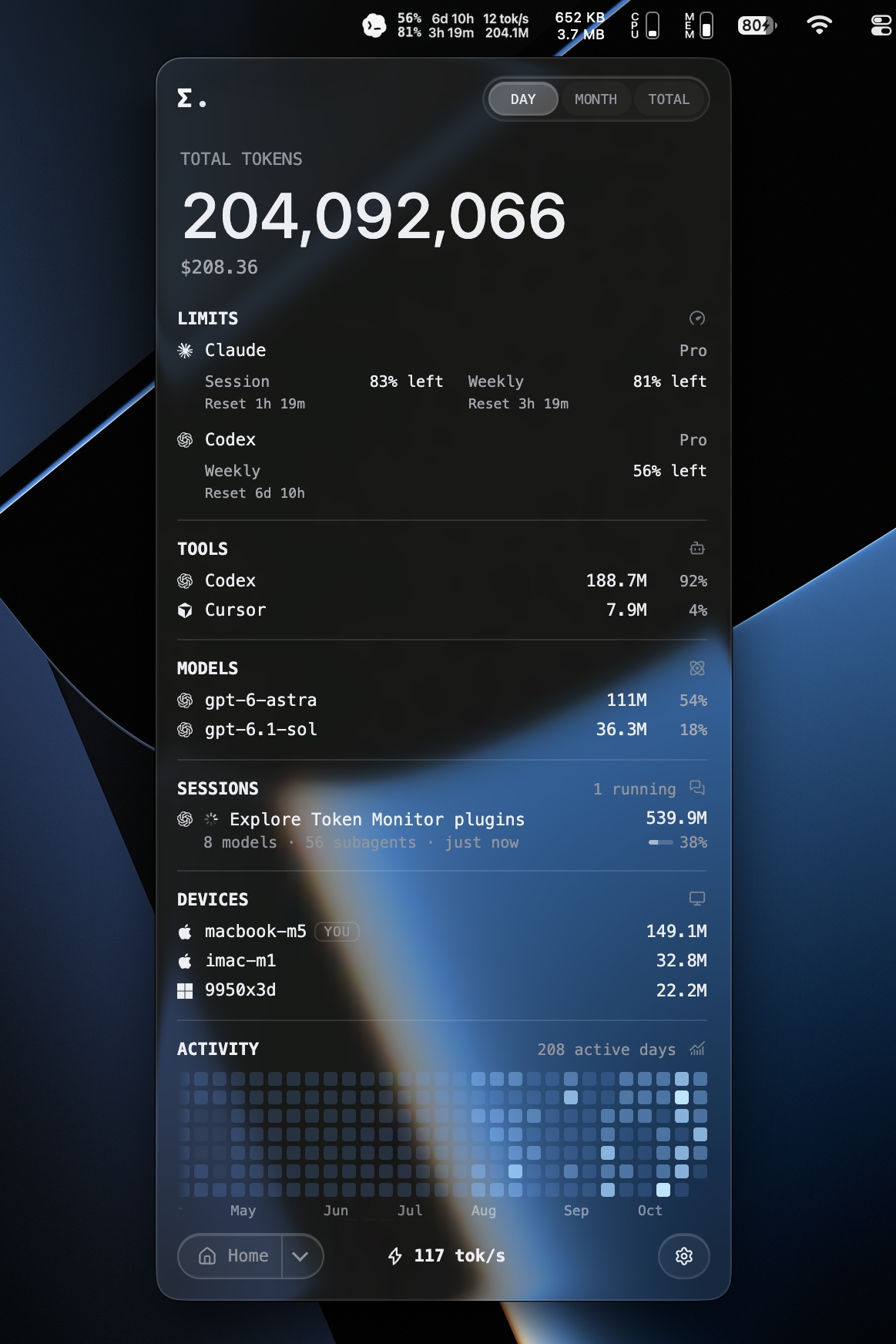 Menu bar & tray — pick a preset or compose your own: tool icons, quota bars, reset times, cost or live tok/s |
Inside the app
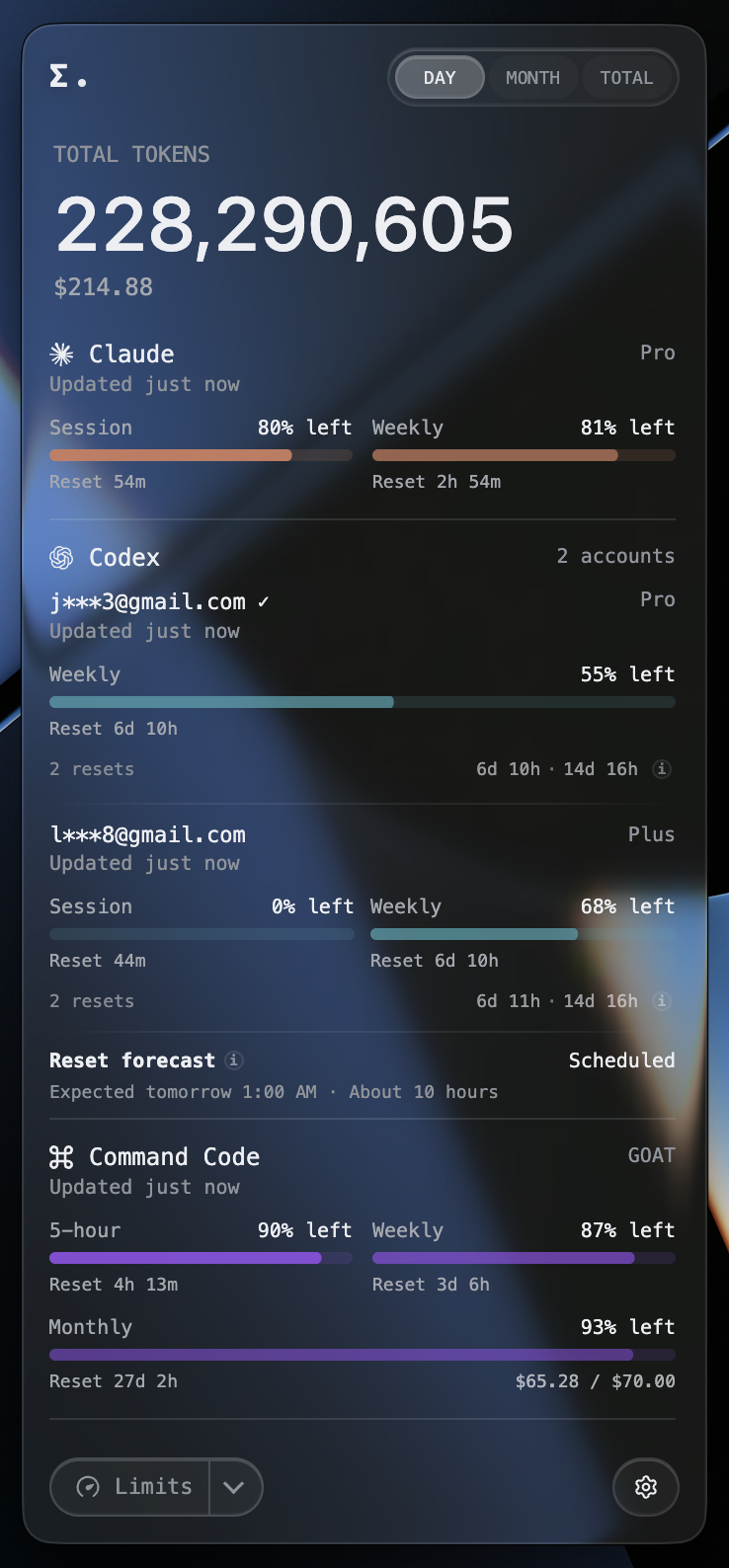 Multiple accounts side by side, one-click switch of the active Codex account |
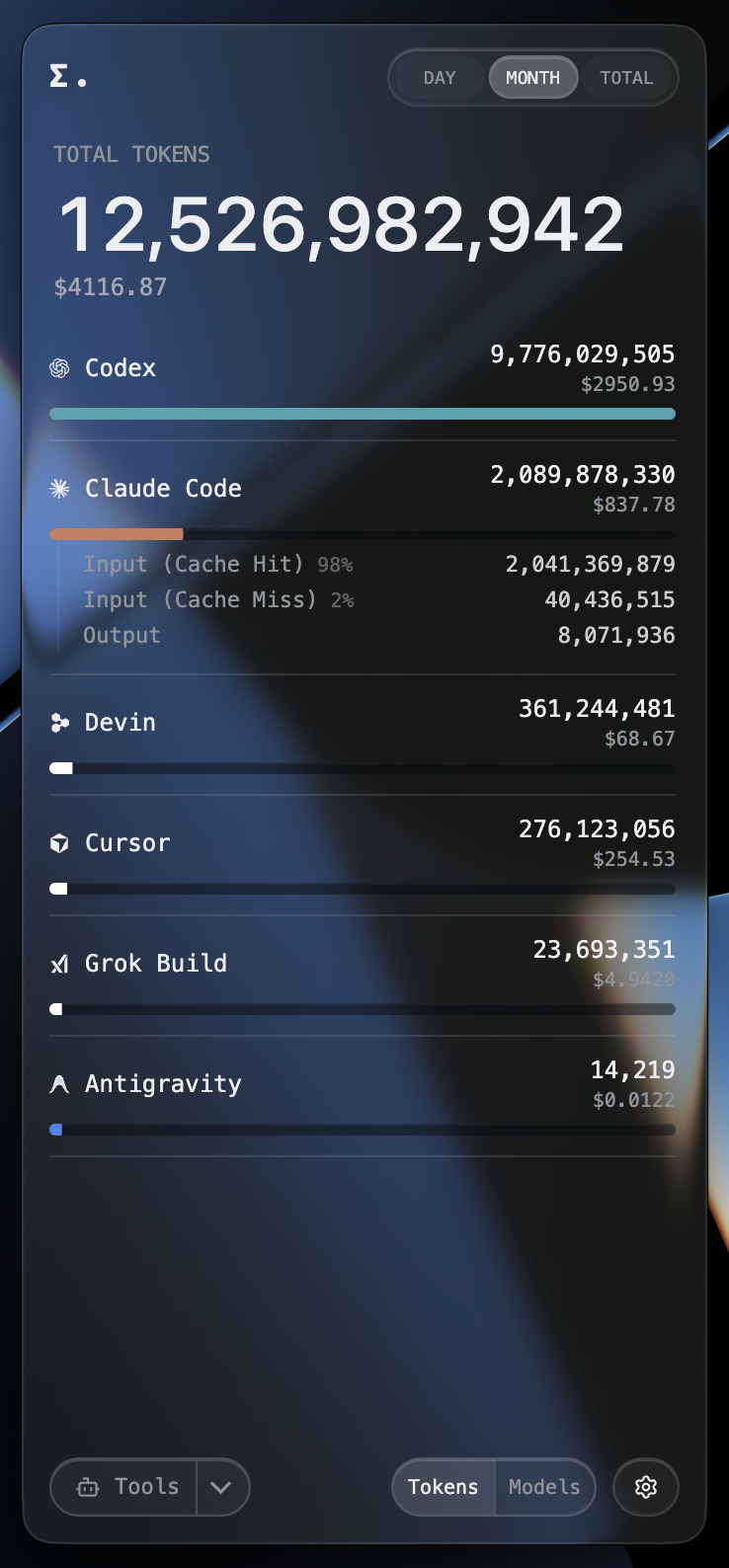 Click any tool to expand input / output and cache-hit detail |
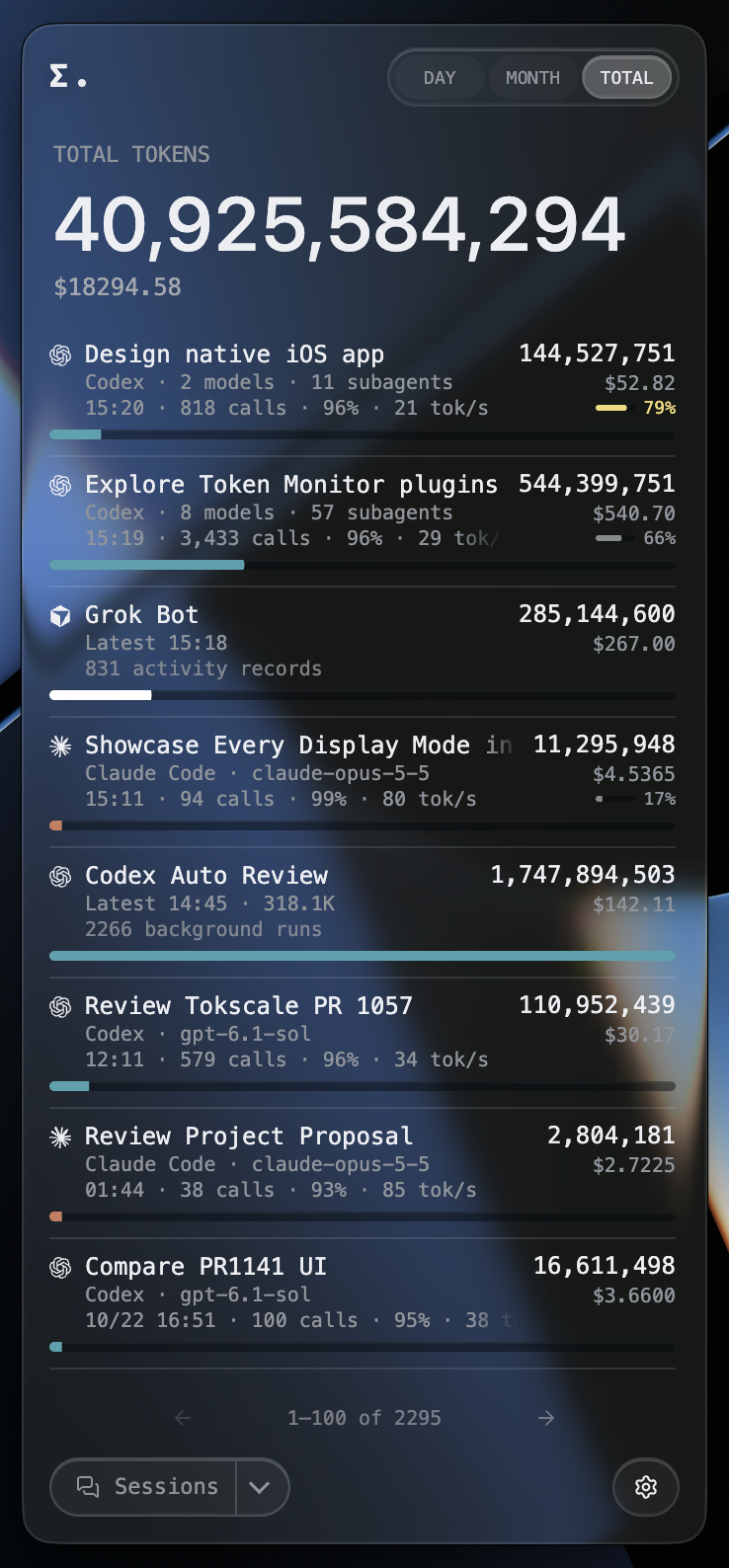 Open a single session to break each prompt into tokens and tools used |
More views — projects, models and devices
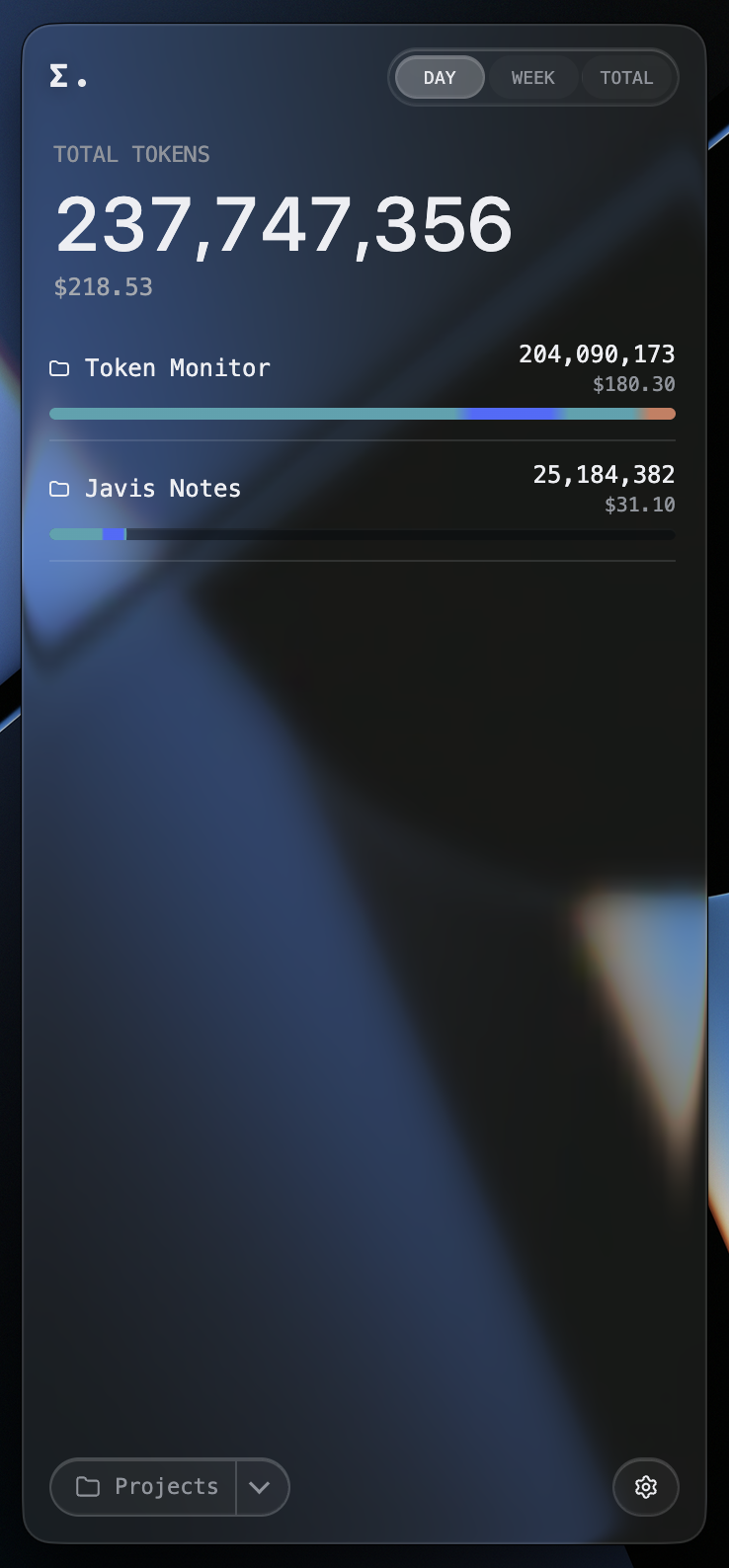 Usage and cost per project, aggregated across tools and devices |
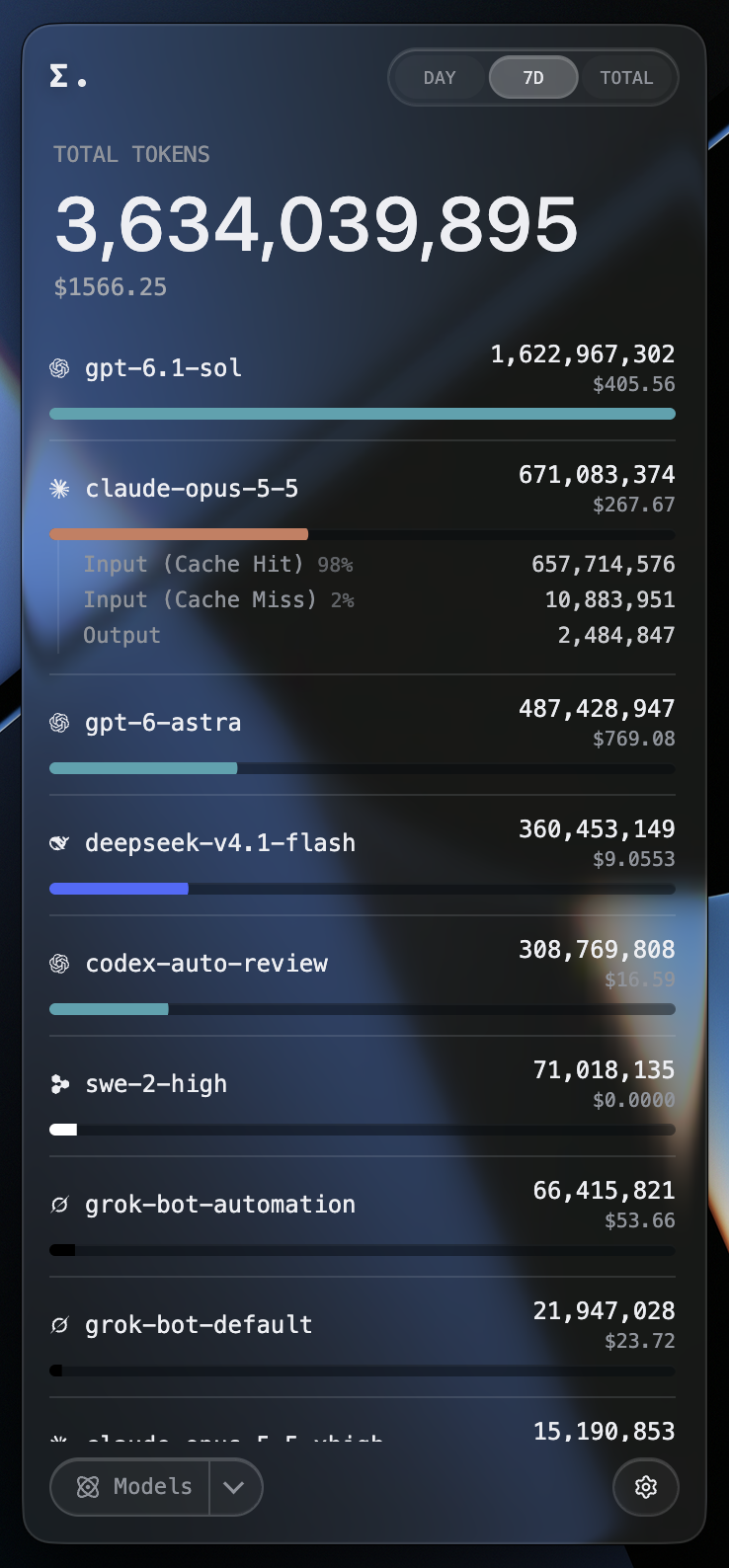 Every model's usage and cost, aggregated across tools |
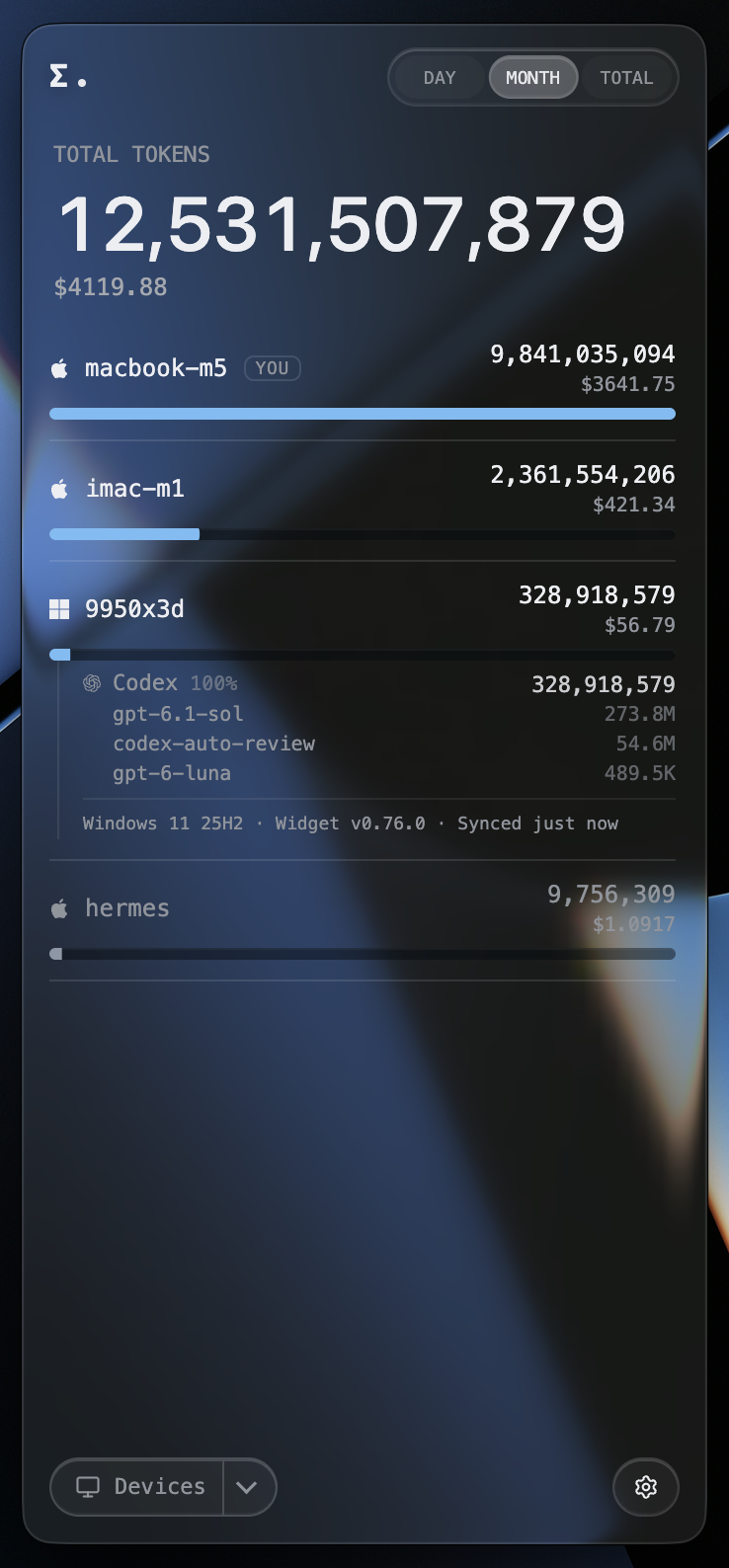 Each device's usage, cost, and sync status — expand for per-machine detail |
Usage Dashboard
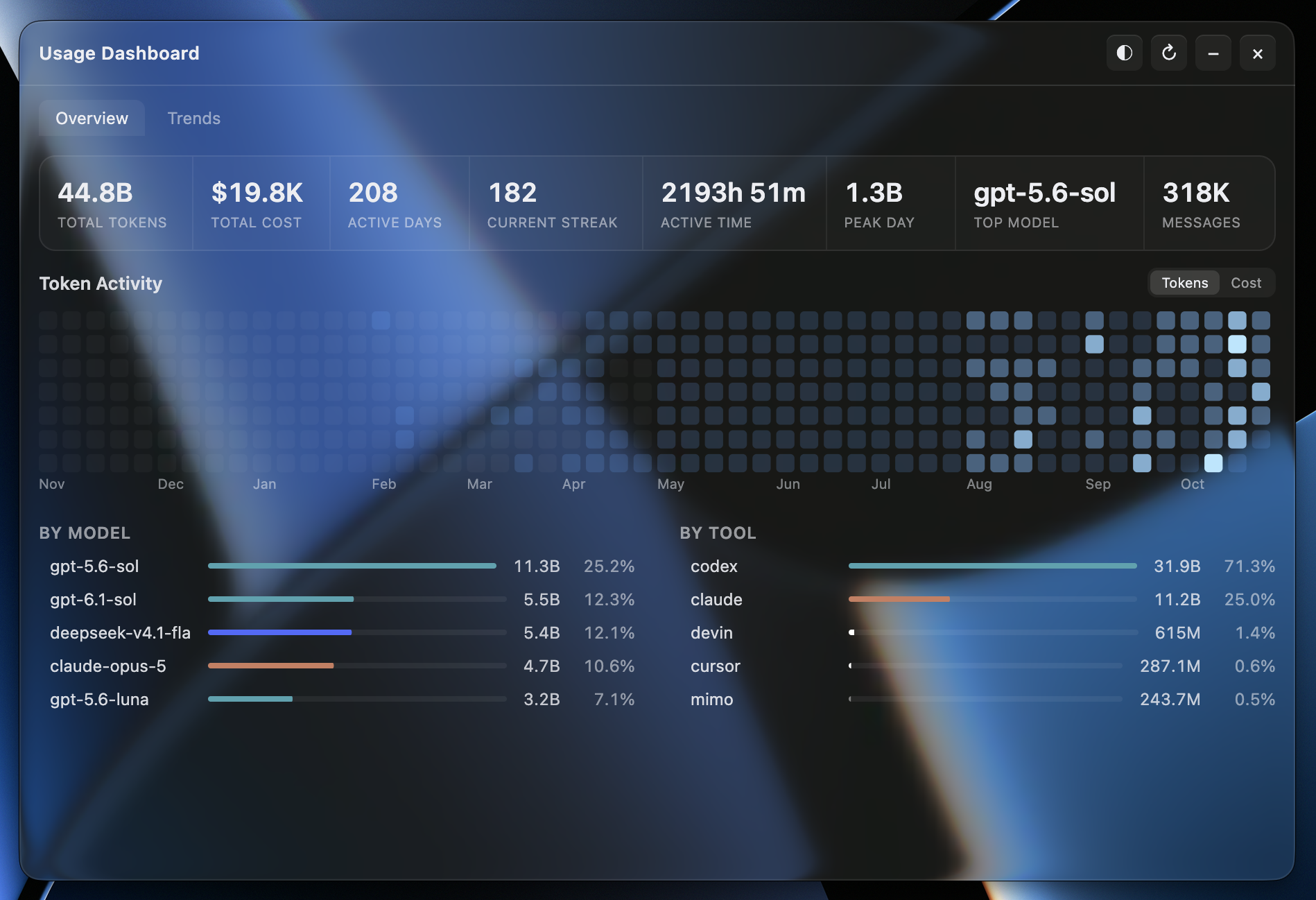 A year of activity heatmap and streaks, aggregated across all devices |
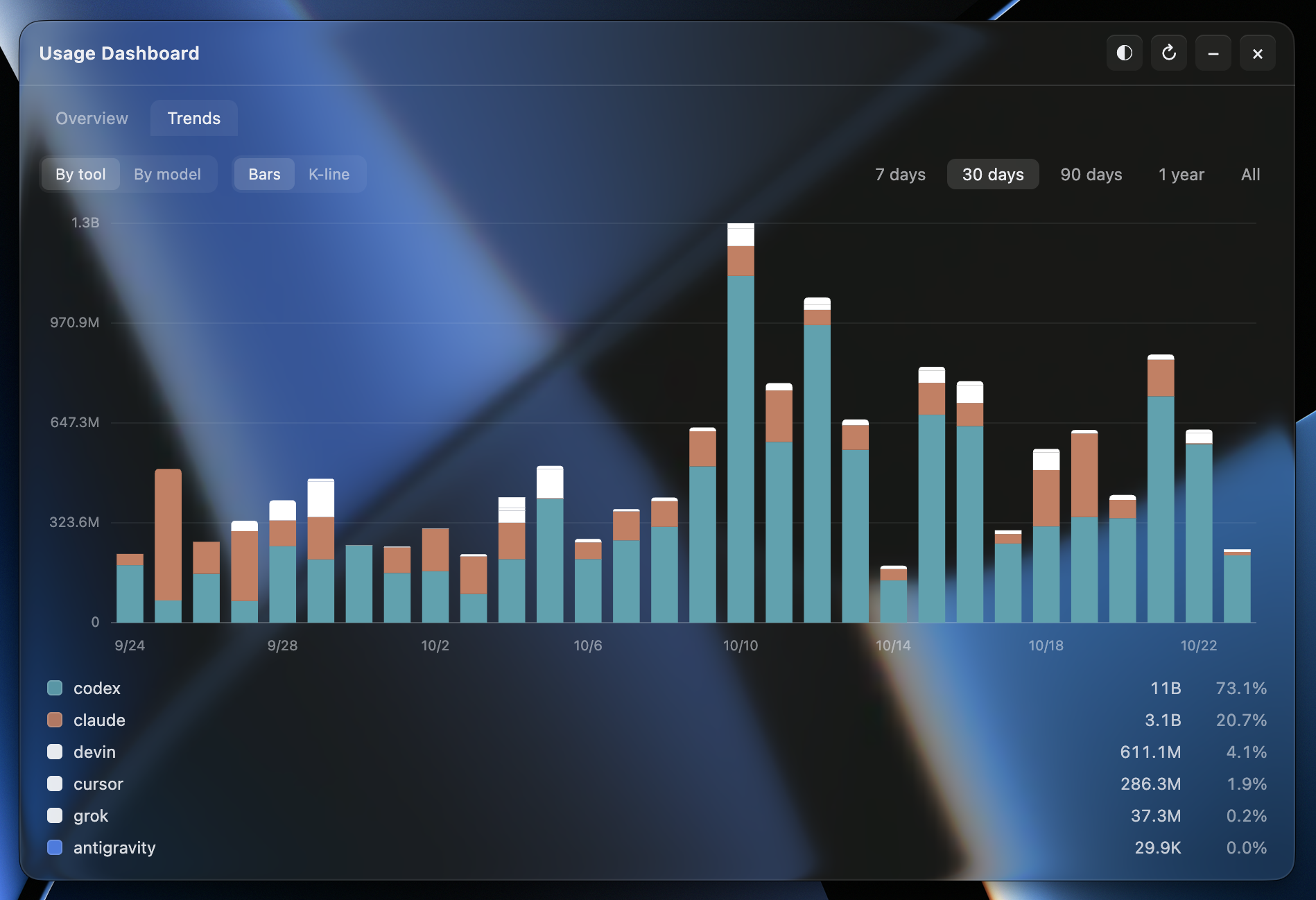 A year of daily trends, stacked by tool / model, with K-line |
Why Token Monitor?
Most usage monitors are useful on the machine they run on. Token Monitor is built for multi-device work: each device watches its own local logs, sends summary updates to your hub, and every connected widget sees token changes almost immediately.
Features
Tracking usage
- Live token tracking — Claude Code, Codex, Cursor, GitHub Copilot, Antigravity, OpenCode, and 38+ AI tools, with the UI updating within seconds of each turn (full list in the table above)
- Live token rate — an optional live readout of generation speed in
tok/sor total burn intok/min - Per-session detail — open a session to see tokens per prompt, expandable to each reply's exact token split and tools used (read on-demand from local transcripts or databases, never synced)
- Cache hit statistics — click any tool or model to expand a detailed breakdown of input tokens (cache hit vs miss), output tokens, and hit-rate percentages
- Cost & currency — cost alongside token counts, shown in USD, TWD, HKD, or CNY; exchange rates auto-update daily and can be manually overridden in Settings
- Custom scan paths — point a tool at extra session folders when yours live outside the defaults
- WSL usage (Windows) — file-based usage from a running WSL distro is detected automatically and merged about every 5 minutes; SQLite-backed tools such as OpenCode and Hermes may require a headless agent inside WSL
Limits, trends & export
- AI Tool Limits detection — provider-specific session, daily, weekly, billing, and credits windows for Claude Code, Codex, Cursor, OpenRouter, third-party APIs, GLM, Kimi, and 30+ providers, including multiple OpenRouter/third-party profiles and balance-style accounts (Claude credits, DeepSeek prepaid balance and spend history, third-party balances)
- Multiple accounts & Codex switching — track several accounts per provider, each with its own limits; a tracked Codex account can be switched as the active local account in one click, without re-authenticating
- Codex reset forecast — an optional third-party forecast below Codex limits, showing the expected reset time, the reset type (Regular or Banked), and when the window last reset
- Preserve deleted session usage — many tools prune old sessions (Claude Code drops transcripts after 30 days by default), losing that history. When enabled, Token Monitor archives observed daily tool/model usage locally so the heatmap and trends survive even after the source files are gone (see Session data retention below)
- Usage Trends & Dashboard — a home-screen activity heatmap and trend chart, plus a dedicated dashboard window with streaks and stacked per-tool/per-model history (bar and K-line views) across all your devices
- Fixed usage ranges — switch between This week, Last 7 days, and Last 30 days alongside the native day, month, and total periods
- Optional Status view — Claude, OpenAI, Cursor, and DeepSeek status pages, with manual or interval re-checks
- Data export — export usage as tool-agnostic CSV + JSON, manually or auto-written to a folder, for spreadsheets, Obsidian, Grafana, or scripts; see docs/export.md
- Subscription records — record by hand what each AI account actually costs; the plan label's tooltip then reports the price, the next renewal or end date, time subscribed, and the month's usage cost as a multiple of what the plan costs, for recurring plans and top-up ledgers alike
Multi-device & deployment
- Real-time multi-device sync — hub-backed sync uses Server-Sent Events to push updates to other devices within seconds; iCloud Drive sync is eventually consistent
- Local-first — no servers needed for single-device use
- Self-hosted sync backend — in-widget hub, Node CLI hub, or Cloudflare Worker
- Headless agent — reports usage from servers, SSH hosts, and WSL without the desktop app; see Headless agent
- iOS widget support — Widgy and Scriptable through the Worker hub
- Privacy-first — prompts, responses, source code, and file contents stay on your machine
Interface & surfaces
- Notch Panel (macOS) — running and waiting sessions sit beside the notch (or in a pill on screens without one); hover or swipe down to open pages for today's usage and the last seven days, every account's limits side by side, active and recent sessions, and tool / model breakdowns
- Edge Dock (macOS & Windows) — keeps quotas and usage at the screen edge, with auto-hide, always-visible, or fullscreen auto-hide modes. Hover cards show account limits, recent sessions, and token usage. Choose, reorder, and configure items in Settings, and toggle it from the menu bar or system tray
- Menu bar (macOS) and system tray (Windows) popover — live cost, tokens, or the closest-to-empty provider limit % next to the icon
- Menu bar layout composer — the menu bar and the floating bubble can use a built-in preset or a layout you build yourself: pick "Custom…" to add AI tool icons, quota bars, percentages, reset times, cost, the live token rate, or custom text, drag to reorder against a live preview, and give each item its own AI tool, account, quota window, and typeface
- Floating Bubble mode — collapses the widget into a draggable mini-window with click or hover preview and tray-style content
- Native macOS Widgets — View token usage and cost, trends, AI tool quota remaining and reset times, activity heatmaps, and breakdowns by tool or model in Small, Medium, and Large layouts on macOS 14+
- Breakdown views — grouped by tool, device, model, session, project, or account limits
- Appearance controls — interface theme switching (incl. a light mode), per-tool vendor colours, glass opacity, blur, transparent window mode, and custom fonts
- Customizable tool list — hide, pin, and reorder tools in the main dashboard without changing what gets tracked
- Recordable global shortcut — show or hide the window from anywhere
- Discord Rich Presence — broadcast today's tokens, cost, and top client (opt-in)
Supported Tools in Detail
Token Monitor supports token usage, account-limit checks, and session details separately:
| Logo | Tool | Data path | Token Usage | AI Tool Limits | Session Details |
|---|---|---|---|---|---|
|
Claude Code | ~/.claude/projects/, ~/.claude/transcripts/ |
✅ | ✅ | ✅ |
|
Codex | ~/.codex/ (sessions/, archived_sessions/) |
✅ | ✅ | ✅ |
|
OpenCode | ~/.local/share/opencode/ (opencode*.db, storage/message/) |
✅ | ✅ | ✅ |
|
Hermes Agent | ~/.hermes/state.db |
✅ | — | — |
|
OpenClaw | ~/.openclaw/agents/ |
✅ | — | — |
|
Cursor IDE / Cursor CLI / Grok Bot | ~/.config/tokscale/cursor-cache/ (account-level usage export) |
✅ | ✅ | — |
|
Antigravity | ~/.gemini/ (antigravity/, antigravity-ide/, antigravity-backup/, antigravity-cli/conversations/) |
✅ | ✅ | — |
|
Cline | VS Code globalStorage tasks (.../saoudrizwan.claude-dev/tasks/), ~/.cline/data/sessions/ |
✅ | ✅ | — |
|
Amp | ~/.local/share/amp/threads/ |
✅ | — | — |
|
Factory Droid | ~/.factory/sessions/ |
✅ | ✅ | — |
|
Kimi CLI / Kimi Code / Kimi Work | ~/.kimi/sessions/, ~/.kimi-code/sessions/, <platform-app-data>/kimi-desktop/ |
✅ | ✅ | — |
|
Qwen CLI | ~/.qwen/projects/ |
✅ | — | — |
|
Grok Build | ~/.grok/ (sessions/, logs/unified.jsonl) |
✅ | ✅ | — |
|
GitHub Copilot | VS Code workspaceStorage/*/chatSessions/, ~/.copilot/ (otel/, data.db, session-store.db) |
✅ | ✅ | — |
|
Pi | ~/.pi/agent/sessions/ |
✅ | — | ✅ |
|
Oh My Pi | ~/.omp/agent/sessions/ |
✅ | — | ✅ |
|
OmO Native | ~/.omo/agent/sessions/, ~/.senpi/agent/sessions/, ~/.omo/senpi-task/children/, <project>/.omo/senpi-task/children/ |
✅ | — | ✅ |
|
Goose | ~/.local/share/goose/sessions/sessions.db |
✅ | — | — |
|
Zed | ~/.local/share/zed/threads/threads.db |
✅ | ✅ | — |
|
Kilo | ~/.local/share/kilo/kilo.db; VS Code globalStorage tasks (.../kilocode.kilo-code/tasks/) |
✅ | — | — |
|
Command Code | ~/.commandcode/projects/**/*.jsonl |
✅ | ✅ | — |
|
MiMo Code / MiMo Desktop | ~/.local/share/mimocode/mimocode.db |
✅ | ✅ | — |
|
Muse Code | ~/.local/share/muse/sessions/ |
✅ | ✅ | — |
|
ZCode / GLM | ~/.zcode/ (projects/, cli/db/db.sqlite) |
✅ | ✅ | — |
|
Kiro | ~/.kiro/sessions/cli/, Kiro IDE globalStorage & kiro-cli DB |
✅ | ✅ | — |
|
CodeBuddy | ~/.codebuddy/projects/ + IDE / VS Code extension logs |
✅ | — | ✅ |
|
WorkBuddy | ~/.workbuddy/projects/, ~/.workbuddy/workbuddy.db |
✅ | ✅ | ✅ |
|
Proma | ~/.proma/agent-sessions/*.jsonl |
✅ | — | — |
|
CatPaw | <platform-app-data>/ (catpaw-moon/, catpaw-overseas/, catpaw-memory-*.db) |
✅ | — | — |
|
Qoder | ~/.qoder-cn/projects/**/*.jsonl, legacy <platform-app-data>/QoderCN/SharedClientCache/cache/db/local.db (CN only) |
✅ | ✅ | — |
|
Reasonix | ~/.reasonix/ (stats/, sessions/, projects/*/sessions/) |
✅ | — | — |
|
DeepSeek / DeepSeek Harness | ~/.dsh/sessions/ (session.jsonl, session.jsonl.zstd) |
✅ | ✅ | ✅ |
|
Cherry Studio | <platform-app-data>/CherryStudio/ (Data/Agents/.claude/projects/ V2, .claude/projects/ legacy) |
✅ | — | — |
|
LM Studio | ~/.lmstudio/server-logs/**/*.log |
✅ | — | — |
|
Unsloth Studio | ~/.unsloth/studio/studio.db |
✅ | — | — |
|
Devin CLI / Devin Desktop | ~/.local/share/devin/cli/sessions.db, <platform-app-data>/Devin/User/acp-events/ |
✅ | ✅ | — |
|
fx | ~/.fx/sessions/ |
✅ | — | — |
|
MiniMax / MiniMax Code | ~/.minimax/v2/sessions/ |
✅ | ✅ | — |
|
TypeSafe | TypeSafe Console Cookie (billing balance and estimated token spend via usage data) | — | ✅ | — |
|
OpenRouter | OpenRouter API key (usage/key limit; balance when credits access is authorized, documented for Management keys) | — | ✅ | — |
|
Volcengine | Ark API key or Volcengine AK/SK (Ark Coding Plan & Agent Plan quota via Volcengine API) | — | ✅ | — |
|
Ollama | Ollama Cloud API key or Cookie (monthly included usage, legacy session/weekly quotas, and credit balances) | — | ✅ | — |
|
Trae CN | Trae CN access token (Trae CN / SOLO credits via trae.cn) | — | ✅ | — |
|
Alibaba Cloud | Alibaba Cloud console cookie (Bailian / Model Studio Token Plan quota, Team & Personal) | — | ✅ | — |
|
StepFun | StepFun Oasis-Token (Coding Plan / Token Plan quota) | — | ✅ | — |
|
Notion AI | Notion AI rolling/monthly allowance for Business/Enterprise; manual token_v2 cookie + explicit workspace ID | — | ✅ | — |
|
Third-party APIs | New API / Sub2API-compatible account presets (including compatible One API forks), a New API API-key preset, and a Custom balance endpoint | — | ✅ | — |
Notes, Custom balance endpoints, and data paths overridden by environment variables
Paths above are the defaults. Token Monitor follows the same environment overrides Tokscale does —
$XDG_DATA_HOMEfor the~/.local/share/roots, and per-tool variables such as$CODEX_HOME,$SENPI_CODING_AGENT_DIR,$SENPI_CODING_AGENT_SESSION_DIR,$GROK_HOME,$HERMES_HOME,$GOOSE_PATH_ROOT,$KIMI_CODE_HOME,$UNSLOTH_STUDIO_HOME,$LM_STUDIO_HOME,$DSH_HOME,$REASONIX_STATE_HOME,$REASONIX_HOMEand the$CLINE_*family.Muse Code subscription limits use
muse usage --jsonfrom Muse Code 1.4.13+ and its existing sign-in. Missing allowance and API-key billing do not provide quota percentages. See the Muse data-source notes.Goose counts all session usage on its creation day, including usage on later days. Remote goosed servers and custom scan paths are not supported. See Goose source notes.
CatPaw is off by default; enable it in Settings → tools. It reads domestic and overseas assistant databases on macOS and Windows. See CatPaw source notes for paths and verification boundaries.
OmO Native tracks local session records from both OmO Native and standalone Senpi. A fresh install tracks it. An existing saved Tools selection does not gain it on upgrade; enable OmO Native in Settings → tools. Some child-task logs count toward usage but do not yet support Session Detail. See OmO Native source notes.
LM Studio tracking currently covers OpenAI-compatible
/v1/chat/completionsand/v1/responsesrequests recorded in server logs. Conversations started from LM Studio's built-in Chat UI and native/api/v1/chatrequests are not included.Unsloth Studio tracks inference usage from
studio.db: Studio chats and its local API. Local inference has zero API cost; recognized metered providers use Tokscale's price estimates. Training tokens are not included. See Unsloth source notes.Devin tracks Devin CLI sessions from the local
sessions.dband Devin Desktop agent sessions fromacp-eventsACP logs; where both cover the same session the CLI database is authoritative. Desktop coverage depends on the connected ACP agent: only agents that writeusage_updateevents locally are counted, and Devin Desktop's defaultdevin-cloudagent meters its usage server-side, so a default Desktop setup reports no Desktop tokens. Session titles and project attribution come from the CLI database. See Devin source notes.Notion AI uses internal APIs with a manually pasted
token_v2cookie and an explicit Business/Enterprise workspace ID. Only fixtures have been validated; a real response sample is unavailable and live authentication awaits approval. There is no automatic cookie retrieval or public API guarantee. See Notion source notes.MiniMax Code reads the local session history the CLI writes, under
~/.minimaxorMINIMAX_DATA_DIR/MAVIS_DATA_DIR(also~/.mavisand~/.minimax-<profile>/~/.mavis-<profile>), plus runs captured withtokscale headless mcode; a turn found in both counts once.Command Code transcripts do not contain actual token counts or per-message model metadata. Token usage is estimated from transcript text, while model attribution and derived cost may reflect the currently configured model rather than the model historically used for each request.
The Cursor cache comes from Cursor's account-level usage export, so it covers usage from Cursor IDE, Cursor CLI, and Grok Bot. Token Monitor automatically detects accounts signed in through the Cursor desktop app and also supports adding accounts manually in Settings. The cache re-syncs automatically when stale, but newly finished sessions can take a few minutes to reach Cursor's dashboard, so recent usage may still appear with a delay.
Custom maps numeric JSON fields from one GET balance endpoint; OpenAI or Anthropic compatibility alone is not enough.
Qoder CN is off by default; enable it in Settings → tools. Current sessions are JSONL under
~/.qoder-cn/projects(TOKEN_MONITOR_QODER_CN_PROJECTS_PATH, thenQODERCN_CONFIG_DIR/projects); older builds used a SQLite database, overridable withTOKEN_MONITOR_QODER_CN_DB_PATH. An unreadable source keeps its last complete read. Legacy database sessions record only a project name, so they appear without a project. Plan-billed JSONL rows that report credits but no token counts are omitted from token totals; those credits stay in AI Tool Limits, and BYOK rows with measured tokens are counted. See Qoder source notes.
Installation
On macOS, install through the official Homebrew Cask:
brew install --cask token-monitor
Or download from GitHub Releases.
- macOS (Apple Silicon) —
.dmg, signed and notarized - macOS (Intel) — x64
.dmg, signed and notarized - Windows 10/11 — setup and portable
.exe, code-signed - Linux x64 —
.AppImage
Packaged builds check GitHub Releases automatically. When an update is available, the app shows an update indicator; supported platforms can also install from Settings → General.
First run
Local mode is the default: launch the app and it starts tracking this device. No hub, agent, or config required.
Multi-device sync
Pick ONE multi-device sync backend for your devices (and any headless agents). On each device, open the widget and pick a mode under Settings → Multi-device Sync. The widget contributes this device's usage automatically; run the headless agent only on machines without a widget. iCloud Drive is a macOS-widget-only option and does not support headless agents.
Option A — Host the hub from the widget (easiest, no CLI)
In the widget on one always-on machine, open Settings → Multi-device Sync and pick Host hub on this device. The widget generates a random secret and lists the LAN URLs other devices can connect to (Tailscale or ZeroTier addresses appear here too). On every other device, pick Connect to a hub and paste the URL + secret.
The hub runs while Token Monitor is running — quitting (not just closing the window) stops it for all connected devices.
Option B — Self-hosted Node hub (always-on headless machine)
# on the always-on machine
cp .env.example .env
# set TOKEN_MONITOR_SECRET to something private, then:
npm run hub
Option C — Cloudflare Worker hub (across networks, including iPhone)
One-click deploy — Cloudflare will prompt for the TOKEN_MONITOR_SECRET during setup. Or deploy manually:
cd worker
npm install
npx wrangler login
npx wrangler secret put TOKEN_MONITOR_SECRET
npx wrangler deploy
Paste the deployed URL into each device's widget at Settings → Multi-device Sync. See worker/README.md for the iOS widget recipe and endpoint reference, or docs/API.md for the hub HTTP API.
Option D — iCloud Drive (macOS, no Hub server)
On each Mac signed into the same Apple ID, choose iCloud Drive in Settings → Multi-device Sync. This is an opt-in macOS-only path: Token Monitor writes one atomic snapshot per device and one subscription snapshot per writer under iCloud Drive/Token Monitor/sync-v1/, then each Mac aggregates the valid files locally. It uses no Token Monitor server, CloudKit, or credentials; provider API keys, cookies, and tokens stay local. iCloud Drive is eventually consistent, so another Mac may take a moment to appear or update, and a missing or malformed file never clears the last-good aggregate.
Headless agent
Run the headless agent on servers, SSH hosts, or inside WSL — anywhere you use AI tools without the desktop widget. It collects usage on that machine and posts it to your hub (Option A, B, or C). Requires Node.js 22.15+ and git.
git clone https://github.com/Javis603/token-monitor.git
cd token-monitor
npm ci
cp .env.example .env              # set TOKEN_MONITOR_HUB_URL, TOKEN_MONITOR_SECRET, and a unique TOKEN_MONITOR_DEVICE_ID
npm run agent                     # run continuously
See docs/headless-agent.md for running it as a service, updating, uninstalling, and troubleshooting. For SQLite-backed tools inside WSL, follow the WSL SQLite setup.
App data
App state lives in the OS user-data dir — delete it along with the app to fully uninstall.
| Platform | Path |
|---|---|
| macOS | ~/Library/Application Support/Token Monitor/ |
| Windows | %APPDATA%/Token Monitor/ |
| Linux | ~/.config/Token Monitor/ |
Build from source
To build your own installer, use Node.js 22.15+ on the target OS (electron-builder can't cross-build a macOS .dmg on Windows, or vice-versa).
npm install
npm run dist:mac     # macOS arm64 .dmg           → dist/
npm run dist:mac:x64 # macOS Intel x64 .dmg       → dist/
npm run dist:win     # Windows x64 installer .exe → dist/
npm run dist:linux   # Linux x64 AppImage         → dist/
npm run pack         # unpacked app dir (no installer), for quick local testing
Output lands in dist/. Windows and Linux use the matching dist:* script above on the target OS. Packaging the macOS release build requires a local Developer ID Application signing identity; use npm start for local development or unsupported platforms.
Runtime and packaging scripts explicitly ensure the pinned tokscale binary on every target with a vendored build. Other source platforms keep the npm binary and filter clients it does not support; npm install, lint, and tests do not download it.
How it works
Mode A — Local (default, no setup)
    widget (Electron) ──▶ tokscale ──▶ ~/.claude, ~/.codex, $HERMES_HOME

Mode B — Sync (opt-in, multi-device)
    device A widget ──▶
    device B widget ──▶  hub  ──▶  widget on any device
    device C agent  ──▶
The widget chooses local vs sync mode based on Settings → Multi-device Sync. The hub itself can run as a separate npm run hub process, a Cloudflare Worker, or directly inside one of the widgets (Host mode). In Hub Client and Host modes, the hub pushes aggregated stats to every connected widget over Server-Sent Events, so updates on one device usually appear on the others within a few seconds. iCloud Drive mode syncs files directly; propagation is eventually consistent and may take longer.
Session data retention
With Preserve deleted session usage enabled (Settings → Collection), Token Monitor archives observed daily tool/model usage locally with no time limit — so even after a source tool prunes its own sessions, the heatmap and trends are unaffected.
Advanced: extend the source tool's own retention
The heatmap and sync payload use a rolling 370-day window (older observations remain available locally for future views). Claude Code keeps only 30 days of transcripts by default (cleanupPeriodDays); to keep the full rolling year before the archive kicks in, raise it in ~/.claude/settings.json before the window passes:
{
  "cleanupPeriodDays": 370
}
A larger value keeps more, at the cost of transcripts living on disk for as long as you set. tokscale's Session Data Retention table covers the other tools' defaults and config paths.
This archive only covers days Token Monitor has already observed; data deleted before it started tracking cannot be recovered.
Settings
There are two places to configure Token Monitor; day-to-day use only needs the first:
- Widget (GUI) — click the
⚙button in the bottom-right corner. Sections, in order: General (language, launch at login, updates), Main (Home modules and display currency), Window (window behavior, menu bar and floating-bubble layout, tray mode, shortcut), Appearance (theme and vendor colours), Collection (tracked tools, collection cadence, Preserve deleted session usage, data export), AI Tool Limits (provider selection, limits, and credentials), Subscriptions (what you pay per account), and Multi-device Sync. The⇧button in the title bar cycles the window behavior. - Headless agent & hub — no UI; configured with a
.envfile at the project root (copy from.env.example), precedence CLI flag → env var → built-in default. See docs/configuration.md.
See the configuration reference for every setting and all environment variables.
Privacy
Token Monitor processes usage logs locally and sends no analytics or telemetry to the project maintainer. Network access occurs only for documented or user-enabled features. See the privacy policy for the data used by updates, provider integrations, Discord Rich Presence, and optional multi-device sync.
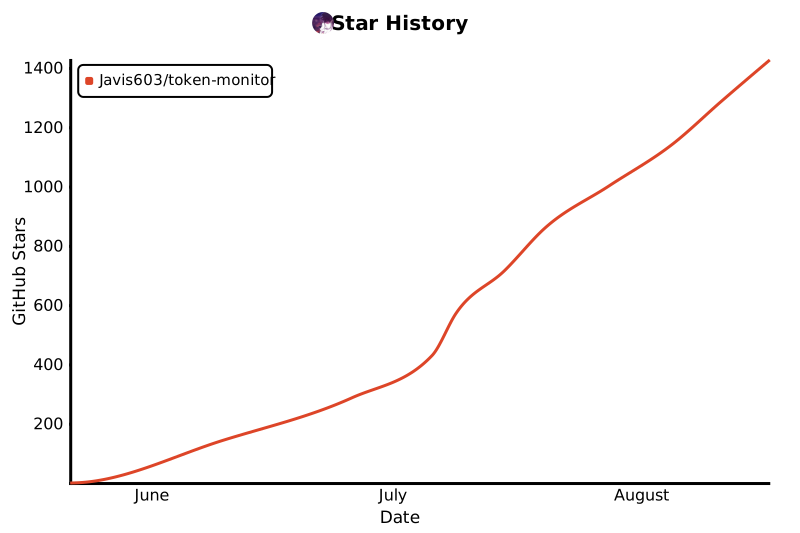
Star History
Contributing
Issues and PRs are welcome. Project conventions, architecture notes, and the command reference live in AGENTS.md — written for coding agents, but it doubles as the contributor guide.
Acknowledgments
- tokscale for log parsing and token accounting.
- CodexBar for AI Tool Limits research.
- Code signing policy: Free code signing provided by SignPath.io, certificate by SignPath Foundation.