yoloshii/ClawMem
On-device memory layer for AI agents. Claude Code, OpenClaw and Hermes. Hooks + MCP server + hybrid RAG search.
ClawMem is an on-device memory layer for Claude Code, OpenClaw, Hermes, and other AI agents, with retrieval-augmented search, hooks, and an MCP server. It uses a local SQLite vault and supports importing conversation exports from Claude Code, ChatGPT, Claude.ai, Slack, and plain text.
- Combines BM25, vector search, rank fusion, and cross-encoder reranking.
- Generates session handoffs and captures decisions and preferences.
- Integrates through hooks, MCP, and native agent plugins.
full readme from github
ClawMem — On-device memory layer for Claude Code, OpenClaw, and Hermes agents

On-device memory for Claude Code, OpenClaw, Hermes, and AI agents. Retrieval-augmented search, hooks, and an MCP server in a single local system. No API keys, no cloud dependencies.
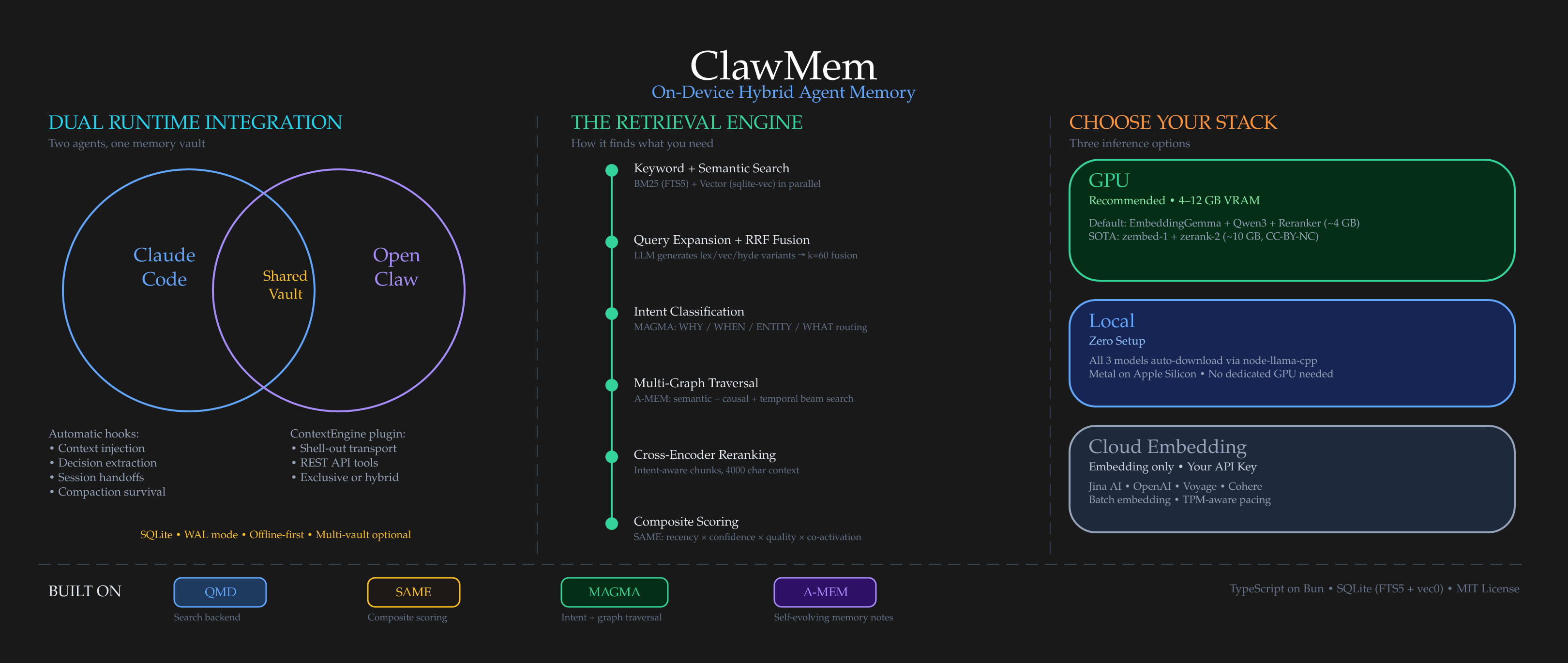
ClawMem fuses recent research into a retrieval-augmented memory layer that agents actually use. The hybrid architecture combines QMD-derived multi-signal retrieval (BM25 + vector search + reciprocal rank fusion + query expansion + cross-encoder reranking), SAME-inspired composite scoring (recency decay, confidence, content-type half-lives, co-activation reinforcement), MAGMA-style intent classification with multi-graph traversal (semantic, temporal, and causal beam search), and A-MEM self-evolving memory notes that enrich documents with keywords, tags, and causal links between entries. Pattern extraction from Engram adds deduplication windows, frequency-based durability scoring, and temporal navigation.
Integrates via Claude Code hooks, an MCP server (works with any MCP-compatible client), a native OpenClaw plugin, or a Hermes Agent MemoryProvider plugin. All paths write to the same local SQLite vault. A decision captured during a Claude Code session shows up immediately when an OpenClaw or Hermes agent picks up the same project.
TypeScript on Bun. MIT License.
What It Does
ClawMem turns your markdown notes, project docs, and research dumps into persistent memory for AI coding agents. It automatically:
- Surfaces relevant context on every prompt (context-surfacing hook)
- Bootstraps sessions with your profile, latest handoff, recent decisions, and stale notes
- Captures decisions, preferences, milestones, and problems from session transcripts using a local GGUF observer model
- Imports conversation exports from Claude Code, ChatGPT, Claude.ai, Slack, and plain text via
clawmem mine, with optional post-import LLM fact extraction (--synthesize) that pulls structured decisions / preferences / milestones / problems and cross-fact links out of otherwise full-text conversation dumps (v0.7.2). Imports preserve authorship time (v0.27.0): ranking recency and temporal queries run on when content was actually written, so historical conversations mined today don't rank as fresh — with a metadata-only--backfill-dateslane for vaults mined earlier - Generates handoffs at session end so the next session can pick up where you left off
- Learns what matters via a feedback loop that boosts referenced notes and decays unused ones
- Guards against prompt injection in surfaced content
- Classifies query intent (WHY / WHEN / ENTITY / WHAT) to weight search strategies
- Traverses multi-graphs (semantic, temporal, causal) via adaptive beam search
- Evolves memory metadata as new documents create or refine connections
- Infers causal relationships between facts extracted from session observations
- Detects contradictions between new and prior decisions, auto-decaying superseded ones — when a contradiction judge is configured (
CLAWMEM_JUDGE_*, v0.29.0; disabled otherwise) (with an additional merge-time contradiction gate in the consolidation worker that blocks cross-observation contradictions before they land, v0.7.1) - Guards against cross-entity merges during consolidation — name-aware dual-threshold merge safety compares entity anchors before merging similar observations, preventing "Alice decided X" from merging into "Bob decided X" (v0.7.1)
- Prevents context bleed in derived insights — the Phase 3 deductive synthesis pipeline validates every draft against an anti-contamination wrapper (deterministic entity contamination check + LLM validator + dedupe) before writing cross-session deductive observations (v0.7.1)
- Frames surfaced facts as background knowledge —
context-surfacingwraps injected content in<instruction>+<facts>+<relationships>blocks, telling the model to treat facts as already-known and exposing memory-graph edges between surfaced docs directly in-prompt (v0.7.1) - Injects knowledge-graph facts as structured triples — when the user's prompt mentions entities already known to the vault,
context-surfacingresolves them via a three-path prompt-only extractor (canonical IDs, proper nouns, lowercased n-grams), queries the SPO graph for current-state triples, and appends a<vault-facts>block of rawsubject predicate objectlines to<vault-context>— off forspeed, 200 tokens onbalanced, 250 ondeep, token-truncated at the triple boundary (v0.9.0) - Session-scoped focus topic —
clawmem focus set "<topic>" --session-id <id>writes a per-session focus file used as a snippet-selection intent: surfaced docs prefer sentences matching the topic. Presentation only since v0.38.0 — a focus never changes expansion, reranking, scoring, ordering, or the surfaced set — session-isolated, fail-open, never writes to SQLite or lifecycle columns (v0.9.0, narrowed v0.38.0) - Ranks hook injections on one channel-aware key — every retrieval leg (BM25, vector, file-aware, gated prior-turn, expansion variants) contributes a ranked lane; weighted reciprocal-rank fusion yields a single ordering key (current-support band, fused mass) that decides membership, final order, AND admission — no mixed raw-score sorts, no metadata reordering (v0.38.0)
- Admits by relevance, abstains honestly — the context-surfacing hook admits candidates by a relative floor on the fused ordering key and abstains at query level when current-turn support is missing or keyword-degenerate, instead of surfacing weak lists (v0.38.0)
- Guards the deep rerank lane — cross-encoder scores apply only under full candidate coverage AND a discriminating score set (degeneracy gate); the reranker joins the final order as a rank-fused lane, and remote rerank scores are cached only under an attested provider identity (
clawmem rerank-health) (v0.38.0) - Keeps the hook's write path off your prompt latency — turn alignment is one early fail-closed row; recall attribution, token accounting, and vault mirrors are handed to a detached drainer process through an on-disk spool after the payload is emitted (v0.38.0)
- Scores document quality using structure, keywords, and metadata richness signals
- Boosts co-accessed documents — notes the agent verifiably referenced together in one turn (v0.41.0) get retrieval reinforcement on the composite MCP surfaces (removed from hook ordering in v0.38.0 — the injected order is the channel-aware fusion key alone)
- Decomposes complex queries into typed retrieval clauses (BM25/vector/graph) for multi-topic questions
- Cleans stale embeddings automatically before embed runs, removing orphans from deleted/changed documents
- Transaction-safe indexing — crash mid-index leaves zero partial state (atomic commit with rollback)
- Processes each turn once — the extraction and handoff hooks keep a cursor per transcript and the feedback hook decides each surfaced turn once (v0.41.0), so a turn is extracted, summarised and credited once instead of again at every response, and each session's documents are its own
- Navigates temporal neighborhoods around any document via the
timelinetool — progressive disclosure from search to chronological context to full content - Boosts frequently-revised memories — documents with higher revision counts get a durability signal in composite scoring (capped at 10%)
- Supports pin/snooze lifecycle for persistent boosts and temporary suppression
- Manages document lifecycle — policy-driven archival sweeps with restore capability
- Auto-routes queries via
memory_retrieve— classifies intent and dispatches to the optimal search backend - Syncs project issues from Beads issue trackers into searchable memory
- Runs a quiet-window heavy maintenance lane — a second consolidation worker, off by default behind
CLAWMEM_HEAVY_LANE=true, that runs on a longer interval only inside a configurable hour window. Gated bycontext_usagequery-rate so it never competes for CPU/GPU with interactive sessions, scoped exclusively via DB-backedworker_leases, stale-first by default with an optional surprisal selector, and journals every attempt inmaintenance_runsfor operator visibility (v0.8.0)
Runs fully local with no API keys and no cloud services. Integrates via Claude Code hooks and MCP tools, as a native OpenClaw plugin, or as a Hermes Agent MemoryProvider plugin. All modes share the same vault for cross-runtime memory. Works with any MCP-compatible client.
Full version history is in RELEASE_NOTES.md. Upgrade instructions for existing vaults are in docs/guides/upgrading.md.
Architecture
Install
Platform Support
| Platform | Status | Notes |
|---|---|---|
| Linux | Full support | Primary target. systemd services for watcher + embed timer. |
| macOS | Full support | Homebrew SQLite handled automatically. GPU via Metal (llama.cpp). |
| Windows (WSL2) | Full support | Recommended for Windows users. Install Bun + ClawMem inside WSL2. |
| Windows (native) | Not recommended | Bun and sqlite-vec work, but bin/clawmem wrapper is bash, hooks expect bash commands, and systemd services have no equivalent. Use WSL2 instead. |
Prerequisites
Required:
- Bun v1.0+ — runtime for ClawMem. On Linux, install via
curl -fsSL https://bun.sh/install | bash(not snap — snap Bun cannot read stdin, which breaks hooks). - SQLite with FTS5 — included with Bun. On macOS, install
brew install sqlitefor extension loading support (ClawMem detects and uses Homebrew SQLite automatically).
Optional (for better performance):
- llama.cpp (
llama-server) — for dedicated GPU inference. Without it,node-llama-cppruns models in-process (auto-downloads on first use). GPU servers give better throughput and prevent silent CPU fallback. - systemd (Linux) or launchd (macOS) — for persistent background services (watcher, embed timer, GPU servers). ClawMem ships systemd unit templates; macOS users can create equivalent launchd plists. See systemd services.
Optional integrations:
- Claude Code — for hooks + MCP integration
- OpenClaw — for native plugin integration
- Hermes Agent — for
MemoryProviderplugin integration - bd CLI v0.58.0+ (verified through v1.1.0) — for Beads issue tracker sync (only if using Beads)
Install from npm (recommended)
npm install -g clawmem
If you use Bun as your package manager:
bun add -g clawmem
Install from source
git clone https://github.com/yoloshii/clawmem.git ~/clawmem
cd ~/clawmem && bun install
ln -sf ~/clawmem/bin/clawmem ~/.bun/bin/clawmem
Setup roadmap
After installing, here's the full journey from zero to working memory:
| Step | What | How | Details |
|---|---|---|---|
| 1. Bootstrap | Create a vault, index your first collection, embed, install hooks and MCP | clawmem bootstrap ~/notes --name notes |
One command does it all. Or run each step manually (see below). |
| 2. Choose models | Pick embedding + reranker models based on your hardware | 16GB+ VRAM → SOTA stack (zembed-1 + zerank-2). Less → QMD native combo. No GPU → cloud embedding or CPU fallback. | Inference services |
| 3. Download models | Get the model files for your chosen stack (GGUFs for all three services; for zerank-2, only a GGUF that carries its score head works) | wget from HuggingFace, let node-llama-cpp auto-download the QMD native models, or build the zerank-2 bf16 sidecar |
Inference services |
| 4. Start services | Run GPU servers (if using dedicated GPU) and background services. Optionally enable the v0.8.2 background maintenance workers in the watcher unit so consolidation + deductive synthesis run automatically. | llama-server for each model. systemd units for watcher + embed timer. Drop-in for the watcher to enable workers + tune intervals + set the quiet window. |
systemd services, background workers |
| 5. Decide what to index | Add collections for your projects, notes, research, and domain docs | clawmem collection add ~/project --name project |
The more relevant markdown you index, the better retrieval works. See building a rich context field. |
| 6. Connect your agent | Hook into Claude Code, OpenClaw, Hermes, or any MCP client | clawmem setup hooks && clawmem setup mcp for Claude Code. clawmem setup openclaw for OpenClaw. Copy src/hermes/ to Hermes plugins for Hermes. |
Integration |
| 7. Verify | Confirm everything is working | clawmem doctor (full health check) or clawmem status (quick index stats) |
Verify Installation |
Fastest path: Step 1 alone gets you a working system with in-process CPU/GPU inference and default models — no manual model downloads or service configuration needed. Steps 2-4 are optional upgrades for better performance. Steps 5-6 are where you customize what gets indexed and how your agent connects.
Customize what gets indexed: Each collection has a pattern field in ~/.config/clawmem/config.yaml (default: **/*.md). Tailor it per collection — index project docs, research notes, decision records, Obsidian vaults, or anything else your agents should know about. The more relevant content in the vault, the better retrieval works. See the quickstart for config examples.
Quick start commands
# One command: init + index + embed + hooks + MCP
clawmem bootstrap ~/notes --name notes

# Or step by step:
clawmem init
clawmem collection add ~/notes --name notes
clawmem update --embed
clawmem setup hooks
clawmem setup mcp

# Add more collections (the more you index, the richer retrieval gets)
clawmem collection add ~/projects/myapp --name myapp
clawmem collection add ~/research --name research
clawmem update --embed

# Verify
clawmem doctor
Upgrading
bun update -g clawmem # or: npm update -g clawmem
Database schema migrates automatically on next startup (new tables and columns are added via CREATE IF NOT EXISTS / ALTER TABLE ADD COLUMN).
After major version updates (e.g. 0.1.x → 0.2.0) that add new enrichment pipelines, run a full enrichment pass to backfill existing documents:
clawmem reindex --enrich  # Full enrichment: entity extraction (backfill) + links + evolution for all docs
clawmem embed             # Re-embed if upgrading embedding models (not needed for most updates)
--enrich runs the complete A-MEM pipeline (entity extraction, link generation, memory evolution) on all documents, not just new ones; entity extraction inside it skips a document unchanged since its last extraction (enrichment lifecycle). Without it, reindex only refreshes metadata for existing docs.
Routine patch updates (e.g. 0.2.0 → 0.2.1) do not require reindexing.
For version-specific upgrade notes (opt-in features, optional cleanup steps, verification commands), see docs/guides/upgrading.md.
Integration
Claude Code
ClawMem integrates via hooks (settings.json) and an MCP stdio server. Hooks handle 90% of retrieval automatically - the agent never needs to call tools for routine context.
clawmem setup hooks    # Install lifecycle hooks (SessionStart, UserPromptSubmit, Stop, PreCompact)
clawmem setup mcp      # Register MCP server in ~/.claude.json (33 tools)
Automatic (90%): context-surfacing injects relevant memory on every prompt. postcompact-inject re-injects state after compaction. decision-extractor, handoff-generator, feedback-loop capture session state on stop.
Agent-initiated (10%): MCP tools (query, intent_search, find_causal_links, timeline, etc.) for targeted retrieval when hooks don't surface what's needed.
OpenClaw
ClawMem registers as a native OpenClaw memory plugin (kind: memory, v0.10.0+). Same 90/10 automatic retrieval, delivered through OpenClaw's plugin-hook bus instead of Claude Code hooks.
# v0.10.4+: profile-aware. Delegates to `openclaw plugins install --force` when the OpenClaw CLI
# is on PATH (auto-enables the plugin, honors OPENCLAW_STATE_DIR, OPENCLAW_CONFIG_PATH, --profile).
# Falls back to a recursive copy honoring OPENCLAW_STATE_DIR when the CLI is absent.
clawmem setup openclaw

# Custom profile (e.g. dev profile at ~/.openclaw-dev):
OPENCLAW_STATE_DIR=~/.openclaw-dev clawmem setup openclaw
What the plugin provides:
before_prompt_buildhook (load-bearing) - prompt-aware retrieval (context-surfacing + session-bootstrap) AND the pre-emptiveprecompact-extractrun when token usage approaches the compaction threshold. This is the authoritative path for precompact state capture because it runs synchronously before the LLM call that would trigger compaction, so it cannot race the compactor.agent_endhook - decision extraction, handoff generation, feedback loop (parallel, fire-and-forget at the OpenClaw call site). OpenClaw v2026.4.26+ also enforces a 30s default void-hook timeout onagent_end— slow handlers are logged but the underlying postrun work is not cancelled (fail-open).before_compactionhook (defense-in-depth fallback) - firesprecompact-extractagain for the rare case wherebefore_prompt_build's proximity heuristic missed a sudden token-count jump. Fire-and-forget at OpenClaw's call site, so it races the compactor and offers no correctness guarantee on its own — thebefore_prompt_buildpath is what actually holds the invariant.session_starthook - session registration + cached first-turn bootstrap context- 5 agent tools -
clawmem_search,clawmem_get,clawmem_session_log,clawmem_timeline,clawmem_similar
Disable OpenClaw's native memory search to avoid duplicate injection:
openclaw config set agents.defaults.memorySearch.extraPaths "[]"
ClawMem coexists cleanly with OpenClaw's Active Memory plugin (v2026.4.10+) and, on OpenClaw v2026.4.18+ (#65411), with the memory-core dreaming sidecar — both run alongside ClawMem instead of being mutually exclusive. They search different backends and inject into different prompt regions, so they do not conflict. See the OpenClaw plugin guide — Active Memory coexistence and the memory-core dreaming sidecar section for the two patterns.
Pair ClawMem (memory) with a context-engine plugin (v0.10.0+). OpenClaw and Hermes maintainers have converged on a two-surface plugin model: one slot for memory plugins (cross-session, retrieval-first) and a separate slot for context-engine plugins (in-session, compression/compaction-first). Under that model ClawMem is a memory layer — it has always been one in Hermes via the MemoryProvider ABC, and v0.10.0 moves the OpenClaw integration to the same semantic slot. You can now run ClawMem in the memory slot alongside an LCM-style compression plugin (for example, lossless-claw) in the context-engine slot. The two plugins do not overlap: one persists across sessions, the other reshapes the live window. See the OpenClaw plugin guide — memory vs context engine for the full rationale.
OpenClaw v2026.4.11+ recommended (required for ClawMem v0.10.0+). v2026.4.11 introduced a new plugin discovery contract that requires each plugin directory to ship a
package.jsonwithopenclaw.extensionsdeclared, and that rejects symlinked plugin directories. ClawMem v0.10.0 includes both fixes. Older ClawMem versions (< v0.10.0) on OpenClaw v2026.4.11+ will fail to discover silently — upgrade ClawMem, then re-runclawmem setup openclaw. See docs/guides/upgrading.md.
Alternative: OpenClaw agents can also use ClawMem's MCP server directly (clawmem setup mcp), with or without hooks. This gives full access to all 33 MCP tools but bypasses OpenClaw's plugin lifecycle, so you lose token budget awareness, native compaction orchestration, and the agent_end message pipeline. The native OpenClaw plugin is recommended for new setups; MCP is available as an additional or standalone integration.
Hermes Agent
ClawMem integrates as a native MemoryProvider plugin — Hermes's pluggable interface for agent memory. Same automatic retrieval and extraction, delivered through Hermes's memory lifecycle instead of Claude Code hooks.
Install:
# Preferred — user-plugin path (Hermes #10529, v2026.4.13+).
# Survives `git pull` of hermes-agent and avoids dual-registration with bundled providers.
# Copies the directory's CONTENTS, so the same command installs and upgrades.
mkdir -p "${HERMES_HOME:-$HOME/.hermes}/plugins/clawmem"
cp -r /path/to/ClawMem/src/hermes/. "${HERMES_HOME:-$HOME/.hermes}/plugins/clawmem/"

# Or, the bundled-style path (always supported, takes precedence on name collisions).
# Recommended only when you actively work in the hermes-agent source tree.
mkdir -p /path/to/hermes-agent/plugins/memory/clawmem
cp -r /path/to/ClawMem/src/hermes/. /path/to/hermes-agent/plugins/memory/clawmem/

# Symlink alternative for in-place development (either path).
ln -s /path/to/ClawMem/src/hermes ${HERMES_HOME:-~/.hermes}/plugins/clawmem
Configure in your Hermes profile's .env or environment:
CLAWMEM_BIN=/path/to/clawmem          # Path to clawmem binary (or ensure it's on PATH)
CLAWMEM_SERVE_PORT=7438                # REST API port (default: 7438)
CLAWMEM_SERVE_MODE=external            # "external" (you run clawmem serve) or "managed" (plugin manages it)
CLAWMEM_PROFILE=balanced               # speed | balanced | deep
Then set memory.provider: clawmem in your Hermes config.yaml, or run hermes memory setup to configure interactively.
What the plugin provides:
prefetch()— prompt-aware retrieval viacontext-surfacinghook (automatic every turn)sync_turn()— appends the turn to the plugin's transcript, then runs decision extraction, handoff generation and the feedback loop over it in the background (v0.41.0: after every turn; each turn is processed once)on_session_end()— a last pass, then the SessionEnd handoff flushon_pre_compress()— pre-compaction state preservationsession-bootstrap— session registration + first-turn context injection- 5 agent tools —
clawmem_retrieve,clawmem_get,clawmem_session_log,clawmem_timeline,clawmem_similar - Plugin-managed transcript — maintains its own JSONL transcript for ClawMem hooks
Requirements: clawmem binary on PATH and clawmem serve running (external mode) or the plugin starts it automatically (managed mode). Python 3.10+. No pip dependencies beyond Hermes itself (uses urllib for REST calls, httpx optional for better performance).
Alternative: Hermes also has built-in MCP client support. You can add ClawMem as an MCP server in Hermes's config.yaml under mcp_servers for tool-only access. But this misses the lifecycle hooks (prefetch, session_end, pre_compress), so the native plugin is recommended.
See Hermes plugin guide for architecture details, lifecycle mapping, and troubleshooting.
Multi-Framework Operation
All three integrations share the same SQLite vault by default. Claude Code, OpenClaw, and Hermes can run simultaneously — decisions captured in one runtime are immediately available in the others, giving agents persistent shared memory across sessions and platforms. WAL mode + busy_timeout handles concurrent access.
Multi-Vault (Optional)
By default, ClawMem uses a single vault at ~/.cache/clawmem/index.sqlite. For users who want separate memory domains (e.g., work vs personal, or isolated vaults per project), ClawMem supports named vaults.
Configure in ~/.config/clawmem/config.yaml:
vaults:
  work: ~/.cache/clawmem/work.sqlite
  personal: ~/.cache/clawmem/personal.sqlite
Or via environment variable:
export CLAWMEM_VAULTS='{"work":"~/.cache/clawmem/work.sqlite","personal":"~/.cache/clawmem/personal.sqlite"}'
Using vaults with MCP tools:
All retrieval tools (memory_retrieve, query, search, vsearch, intent_search) accept an optional vault parameter. Omit it to use the default vault.
# Search the default vault (no vault param needed)
query("authentication flow")

# Search a named vault
query("project timeline", vault="work")

# List configured vaults
list_vaults()

# Sync content into a vault
vault_sync(vault="work", content_root="~/work/docs")
Single-vault users: No action needed. Everything works without configuration. The vault parameter is always optional and ignored when no vaults are configured.
Inference services (GPU, in-process, or cloud)
ClawMem uses three inference services — embedding, LLM (query expansion / intent / A-MEM / the Stop hooks' observer), and reranker. In the default stack all three run as llama-server instances, each with an in-process node-llama-cpp fallback that auto-downloads on first use, so ClawMem works without a dedicated GPU (Metal on Apple Silicon, Vulkan where available, CPU as last resort). The bin/clawmem wrapper points at localhost:8088/8089/8090. Always run via bin/clawmem — it sets the endpoints.
Choose a stack:
| Stack | Models | VRAM | License | When |
|---|---|---|---|---|
| QMD native (default) | EmbeddingGemma-300M + qmd-query-expansion-1.7B + qwen3-reranker-0.6B | ~4 GB, or in-process | Permissive — commercial OK | Any GPU or none; zero-config start |
| z / SOTA | zembed-1 + qmd-query-expansion-1.7B + zerank-2 (Q8_0 GGUF that carries its score head) | ~13 GB | Apache-2.0 — commercial OK | 16 GB+ GPU; best recall |
| Cloud embedding | Jina / OpenAI / Voyage / Cohere (embedding only) | none | provider ToS | No local GPU for embedding; LLM + reranker stay local |
Heads-up before you serve: most zerank-2 GGUFs are inert — llama.cpp's standard converter drops the score head. Serve the Q8_0 GGUF that carries it (launch line) or the bf16 seq-cls sidecar, and verify with clawmem rerank-health. zembed-1 / reranking need -ub = -b (non-causal attention). Changing embedding dimensions requires clawmem embed --force. Set CLAWMEM_NO_LOCAL_MODELS=true to fail fast instead of silent CPU fallback.
→ Full stack decision matrix, model/VRAM tables, and server-setup commands: docs/guides/inference-services.md. Cloud providers, batch + TPM behavior: docs/guides/cloud-embedding.md. All environment variables: docs/reference/configuration.md. Keeping servers running: docs/guides/systemd-services.md.
MCP Server
ClawMem exposes 33 MCP tools via the Model Context Protocol and an optional HTTP REST API. Any MCP-compatible client or HTTP client can use it.
Claude Code (automatic):
./bin/clawmem setup mcp # Registers in ~/.claude.json
Manual (any MCP client):
Add to your MCP config (e.g. ~/.claude.json, claude_desktop_config.json, or your client's equivalent):
{
  "mcpServers": {
    "clawmem": {
      "command": "/absolute/path/to/clawmem/bin/clawmem",
      "args": ["mcp"]
    }
  }
}
The server runs via stdio — no network port needed. The bin/clawmem wrapper sets the GPU endpoint env vars automatically.
Verify: After registering, your client should see tools including memory_retrieve, search, vsearch, query, query_plan, intent_search, timeline, etc.
HTTP REST API (optional)
For web dashboards, non-MCP agents, cross-machine access, or programmatic use:
./bin/clawmem serve                          # localhost:7438; every request needs the token (below)
./bin/clawmem serve --port 8080              # custom port
./bin/clawmem serve-token                    # print the token serve uses
Endpoints:
| Method | Path | Description |
|---|---|---|
| GET | /health |
Liveness probe + version + doc count |
| GET | /stats |
Full index statistics |
| POST | /search |
Unified search (mode: auto/keyword/semantic/hybrid) |
| POST | /retrieve |
Smart retrieve with auto-routing (mode: auto/keyword/semantic/causal/timeline/hybrid) |
| GET | /documents/:docid |
Single document by 6-char hash prefix |
| GET | /documents?pattern=... |
Multi-get by glob pattern |
| GET | /timeline/:docid |
Temporal neighborhood (before/after) |
| GET | /sessions |
Recent session history |
| GET | /collections |
List all collections |
| GET | /lifecycle/status |
Active/archived/forgotten/pinned/snoozed counts + deactivation_reasons (absent/forget/archive/unknown_legacy) |
| POST | /documents/:docid/pin |
Pin/unpin |
| POST | /documents/:docid/snooze |
Snooze until date |
| POST | /documents/:docid/forget |
Deactivate |
| POST | /lifecycle/sweep |
Archive stale docs (dry_run default) |
| GET | /graph/causal/:docid |
Causal chain traversal |
| GET | /graph/similar/:docid |
k-NN neighbors |
| GET | /export |
Active-document export as JSON (?full=true includes legacy precompact-state.md snapshot copies) |
| POST | /reindex |
Trigger re-scan |
| POST | /graphs/build |
Rebuild temporal + semantic graphs |
Auth (v0.42.0): every request needs Authorization: Bearer <token>: CLAWMEM_API_TOKEN when set (32+ characters), otherwise the token file serve generates at ~/.config/clawmem/serve-token; clawmem serve-token prints it. Every POST needs Content-Type: application/json, and requests from web pages (a foreign Origin or Host) are refused. See the REST API reference.
Search example:
curl -X POST http://localhost:7438/search \
  -H "Authorization: Bearer $(clawmem serve-token)" \
  -H 'Content-Type: application/json' \
  -d '{"query": "authentication decisions", "mode": "hybrid", "compact": true}'
Verify Installation
./bin/clawmem doctor   # Full health check
./bin/clawmem status   # Quick index status
bun test               # Run test suite (from the repository root)
Agent Instructions
ClawMem ships agent instruction files and an optional maintenance agent:
| File | Loaded | Purpose |
|---|---|---|
AGENTS.md |
Automatically (most agents, when working in this repo) | Lean root SSOT — agent-facing quick reference (inference at a glance, install, retrieval routing, MCP tools, indexing rules, integrations) + an index into docs/ |
CLAUDE.md |
Automatically (Claude Code) | @AGENTS.md import — Claude Code reads CLAUDE.md natively, so it just pulls in the SSOT |
SKILL.md |
On-demand (agent reads when needed) | Portable operating reference — escalation gate, tool routing, the 4 query-optimization levers, pipeline behavior, composite scoring, lifecycle. Shipped with the package for cross-project use |
docs/ |
On-demand (linked throughout AGENTS.md) |
Deep reference — inference setup, configuration, concepts, internals, guides, troubleshooting |
agents/clawmem-curator.md |
On-demand via clawmem setup curator |
Maintenance agent — lifecycle triage, retrieval health checks, dedup sweeps, graph rebuilds |
Working in the ClawMem repo: No action needed — CLAUDE.md (which imports AGENTS.md) loads automatically.
Using ClawMem from other projects: Your agent needs instructions on how to use ClawMem's hooks and MCP tools. Two options:
Option A: Copy instructions into your project
Copy the contents of AGENTS.md (or the relevant sections) into your project's own AGENTS.md or CLAUDE.md. Simple but requires manual updates when ClawMem changes.
Option B: Add a trigger block (recommended)
Add this minimal trigger block to your global ~/.claude/CLAUDE.md. It gives the agent routing rules always loaded, and tells it how to find the full reference (SKILL.md) shipped with your installation when deeper guidance is needed:
## ClawMem

Architecture: hooks (automatic, ~90%) + MCP tools (explicit, ~10%).

Vault: `~/.cache/clawmem/index.sqlite` | Config: `~/.config/clawmem/config.yaml`

### Escalation Gate (3 rules — ONLY escalate to MCP tools when one fires)

1. **Low-specificity injection** — `<vault-context>` is empty or lacks the specific fact needed
2. **Cross-session question** — "why did we decide X", "what changed since last time"
3. **Pre-irreversible check** — before destructive or hard-to-reverse changes

### Tool Routing (once escalated)

**Preferred:** `memory_retrieve(query)` — auto-classifies and routes to the optimal backend.

**Direct routing** (when calling specific tools):

    "why did we decide X"         → intent_search(query)          NOT query()
    "what happened last session"  → session_log()                 NOT query()
    "what else relates to X"      → find_similar(file)            NOT query()
    Complex multi-topic           → query_plan(query)             NOT query()
    General recall                → query(query, compact=true)
    Keyword spot check            → search(query, compact=true)
    Conceptual/fuzzy              → vsearch(query, compact=true)
    Full content                  → multi_get("path1,path2")
    Lifecycle health              → lifecycle_status()
    Stale sweep                   → lifecycle_sweep(dry_run=true)
    Restore archived              → lifecycle_restore(query)

ALWAYS `compact=true` first → review → `multi_get` for full content.

### Proactive Use (no escalation gate needed)

- User says "remember this" / critical decision made → `memory_pin(query)` immediately
- User corrects a misconception → `memory_pin(query)` the correction
- `<vault-context>` surfaces irrelevant/noisy content → `memory_snooze(query, until)` for 30 days
- Need to correct a memory → `memory_forget(query)`
- After bulk ingestion → `build_graphs`

### Anti-Patterns

- Do NOT use `query()` for everything — match query type to tool, or use `memory_retrieve`
- Do NOT call query/intent_search every turn — 3 rules above are the only gates
- Do NOT re-search what's already in `<vault-context>`
- Do NOT pin everything — pin is for persistent high-priority items, not routine decisions
- Do NOT forget memories to "clean up" — let confidence decay handle it
- Do NOT wait for curator to pin decisions — pin immediately when critical

For detailed operating guidance (escalation gate, tool routing, query-optimization levers, pipeline behavior, composite scoring, lifecycle), find and read the shipped SKILL.md (setup, inference, and internals live in AGENTS.md + docs/):
  Bash: CLAWMEM_ROOT=$(cd "$(dirname "$(which clawmem)")/.." && pwd) && echo "$CLAWMEM_ROOT/SKILL.md"
  Then: Read the file at that path.
This gives your agent the 3-rule gate, tool routing, and proactive behaviors always loaded. When it needs deeper guidance, it locates and reads the full SKILL.md reference shipped with your installation — no symlinks or skill registration required.
CLI Reference
clawmem init                                    Create DB + config
clawmem bootstrap <vault> [--name N] [--skip-embed]  One-command setup
clawmem collection add <path> --name <name>     Add a collection
clawmem collection list                         List collections
clawmem collection remove <name>                Remove a collection

clawmem update [--pull] [--embed]               Incremental re-scan
clawmem mine <dir> [-c name] [--embed] [--synthesize]  Import conversation exports (--synthesize runs post-import LLM fact extraction, v0.7.2; preserves per-exchange authored_at, v0.27.0)
clawmem mine <dir> -c name --backfill-dates [--apply]  Derive authored_at for already-mined docs (metadata-only; dry-run without --apply)
clawmem embed [-f]                              Generate fragment embeddings
clawmem reindex [--force]                       Full re-index
clawmem watch                                   File watcher daemon

clawmem search <query> [-n N] [--json]          BM25 keyword search
clawmem vsearch <query> [-n N] [--json]         Vector semantic search
clawmem query <query> [-n N] [--json]           Full hybrid pipeline

clawmem profile                                 Show user profile
clawmem profile rebuild                         Force profile rebuild
clawmem update-context                          Regenerate per-folder CLAUDE.md

clawmem list [-n/--limit N] [-c col] [--json]   Browse recent documents
clawmem budget [--session ID]                   Token utilization
clawmem log [--last N]                          Session history
clawmem hook <name>                             Manual hook trigger
clawmem surface --context --stdin               IO6: pre-prompt context injection
clawmem surface --bootstrap --stdin             IO6: per-session bootstrap injection

clawmem reflect [N]                             Cross-session reflection (last N days, default 14)
clawmem consolidate [--dry-run] [N]             Find and archive duplicate low-confidence docs
clawmem eval run --gold <file.jsonl>            Offline eval: replay gold-labeled queries, score J_doc/recall/MRR

clawmem install-service [--enable] [--remove]   Systemd watcher service
clawmem setup hooks [--remove]                  Install/remove Claude Code hooks
clawmem setup mcp [--remove]                    Register/remove MCP server
clawmem setup curator [--remove]                Install/remove curator maintenance agent
clawmem mcp                                     Start stdio MCP server
clawmem serve [--port 7438] [--host 127.0.0.1] [--no-token]  Start HTTP REST API server (token required)
clawmem serve-token                             Print the token serve uses
clawmem path                                    Print database path
clawmem doctor                                  Full health check
clawmem status                                  Quick index status
MCP Tools (31)
Registered by clawmem setup mcp. Available to any MCP-compatible client.
Internal-collection visibility (v0.21.0): the retrieval tools search, vsearch, query, query_plan, memory_retrieve, and find_similar (plus memory_rank since v0.36.0) exclude the system-internal _clawmem collection by default — pass includeInternal: true (or name _clawmem in an explicit collection filter where the tool has one) to include it. find_similar auto-includes internal neighbors when the reference document is itself internal; intent_search, find_causal_links, kg_query, session_log, and timeline are unfiltered by design. Full contract (including the degraded under-fill markers): docs/reference/mcp-tools.md.
| Tool | Description |
|---|---|
__IMPORTANT |
Workflow guide: prefer memory_retrieve → match query type to tool → multi_get for full content |
Core Search & Retrieval
| Tool | Description |
|---|---|
memory_retrieve |
Preferred entry point. Auto-classifies query and routes to optimal backend (query, intent_search, session_log, find_similar, or query_plan). Use instead of manually choosing a search tool. |
search |
BM25 keyword search — for exact terms, config names, error codes, filenames. v0.24.0: non-recency queries rank by the RAW BM25 transform (scoreBasis: "fts-bm25"; judged keyword eval MRR 0.848 vs composite 0.415; metadata breaks exact ties only; minScore filters raw, no default); recency-intent queries keep composite. Collection filter supports comma-separated values. Prefer memory_retrieve for auto-routing. |
vsearch |
Vector semantic search — for conceptual/fuzzy matching when exact keywords are unknown. v0.22.0: non-recency queries rank by RAW cosine (scoreBasis: "vector-cosine"; metadata breaks exact ties only; minScore filters raw with no default); recency-intent queries keep composite. Collection filter supports comma-separated values. Prefer memory_retrieve for auto-routing. |
query |
Full hybrid pipeline (BM25 + vector + rerank) — general-purpose when query type is unclear. WRONG for "why" questions (use intent_search) or cross-session queries (use session_log). Prefer memory_retrieve for auto-routing. Intent hint, strong-signal bypass, chunk dedup, candidateLimit, MMR diversity, compact mode. |
get |
Retrieve single document by path or docid |
multi_get |
Retrieve multiple docs by glob or comma-separated list |
find_similar |
USE THIS for "what else relates to X", "show me similar docs". Finds k-NN vector neighbors — discovers connections beyond keyword overlap that search/query cannot find. |
Intent-Aware Search
| Tool | Description |
|---|---|
intent_search |
USE THIS for "why did we decide X", "what caused Y", "who worked on Z". Classifies intent (WHY/WHEN/ENTITY/WHAT), traverses causal + semantic graph edges. Returns decision chains that query() cannot find. |
query_plan |
USE THIS for complex multi-topic queries ("tell me about X and also Y", "compare A with B"). Decomposes into parallel typed clauses (bm25/vector/graph), executes each, merges via RRF. query() searches as one blob — this tool splits topics and routes each optimally. |
intent_search pipeline: Query → Intent Classification → BM25 + Vector → Intent-Weighted RRF → Graph Expansion (WHY/ENTITY intents) → Cross-Encoder Reranking → Composite Scoring
query_plan pipeline: Query → LLM decomposition into 2-4 typed clauses → Parallel execution (BM25/vector/graph per clause) → RRF merge across clauses → Composite scoring. Falls back to single-query for simple inputs.
Multi-Graph & Causal
| Tool | Description |
|---|---|
build_graphs |
Build temporal and/or semantic graphs from document corpus |
find_causal_links |
Trace decision chains: "what led to X", "how we got from A to B". Follow up intent_search with this tool on a top result to walk the full causal chain. Traverses causes / caused_by / both up to N hops with depth-annotated reasoning. |
kg_query |
Query the SPO knowledge graph: "what does X relate to?", "what was true about X when?". Returns temporal entity-relationship triples with validity windows. Accepts an entity name or a canonical ID in vault:type:slug form; an exact name wins over a partial match, and entities that share the name are listed separately (resolution). Triples are populated by the decision-extractor hook from observer-emitted <triples> blocks. |
memory_evolution_status |
Show how a document's A-MEM metadata evolved over time |
timeline |
Show the temporal neighborhood around a document — what was created/modified before and after it. Progressive disclosure: search → timeline (context) → get (full content). Supports same-collection scoping and session correlation. |
Beads Integration
| Tool | Description |
|---|---|
beads_sync |
Sync Beads issues from Dolt backend (bd CLI) into memory: syncs the full backlog (no 50-issue cap), creates docs, bridges all dep types to memory_relations, surfaces bd ≥1.1.0 claim leases, runs A-MEM enrichment |
Vault Management
| Tool | Description |
|---|---|
list_vaults |
Show configured vault names and paths. Empty in single-vault mode. |
vault_sync |
Index markdown from a directory into a named vault. Restricted-path validation rejects sensitive directories. |
Agent Diary
| Tool | Description |
|---|---|
diary_write |
Write a diary entry. Use for recording important events, decisions, or observations in environments without hook support. Stored as searchable memories. |
diary_read |
Read recent diary entries. Filter by agent name. |
Memory Management & Lifecycle
| Tool | Description |
|---|---|
memory_forget |
Search → deactivate closest match (with audit trail). Weak matches return a disambiguation list instead of acting (v0.23.0) |
memory_pin |
Pin a memory: lifecycle retention + priority among relevance-equivalent results (+0.3 composite boost on hook/query surfaces; exact-tie precedence on the raw routes — vector + search non-recency). USE PROACTIVELY when: user states a persistent constraint, makes an architecture decision, or corrects a misconception. Don't wait for curator — pin critical decisions immediately. |
memory_snooze |
Temporarily hide a memory from context surfacing until a date. USE PROACTIVELY when <vault-context> repeatedly surfaces irrelevant content — snooze for 30 days instead of ignoring it. |
status |
Index health with content type distribution |
reindex |
Trigger vault re-scan |
index_stats |
Detailed stats: types, staleness, access counts, sessions |
memory_stats |
Lifecycle + ranking-metadata aggregates per collection (v0.36.0): origin×active cross-tabs, pinned, accrual, deactivation reasons, and access/confidence/quality/effective-age distributions (mean/median/min/max over active rows). Deeper than index_stats; includes system collections. |
memory_rank |
Ranking diagnostic (v0.36.0): real-pipeline composite breakdown per result — weights, recency, confidence blend, quality/length/frequency/canonical multipliers, signed pinΔ, co-activation — plus raw-vs-composite rank shifts; demoted raw winners stay visible. FTS-only candidates; read-only. |
session_log |
USE THIS for "last time", "yesterday", "what happened", "what did we do". Returns session history with handoffs and file changes. DO NOT use query() for cross-session questions — this tool has session-specific data that search cannot find. |
profile |
Current static + dynamic user profile |
lifecycle_status |
Document lifecycle statistics: active, archived, forgotten, pinned, snoozed counts, the deactivation-reason breakdown, and policy summary |
lifecycle_sweep |
Run lifecycle policies: archive stale docs past retention threshold. Archives only — never deletes. Defaults to dry_run (preview only) |
lifecycle_restore |
Restore documents that were auto-archived by lifecycle policies. Filter by query, collection, or restore all |
ClawMem never physically deletes a document row (v0.30.0). Forget and archive deactivate; lifecycle_restore reverses archival; purge_after_days is inert. Through v0.29.0 a configured retention window permanently deleted archived rows from a non-dry-run sweep and from the SessionStart hook, without reporting it — see upgrading.
Compact Mode
search, vsearch, and query accept compact: true to return { id, path, title, score, snippet, content_type, fragment } instead of full content. Saves ~5x tokens for initial filtering.
Hooks (Claude Code Integration)
Hooks installed by clawmem setup hooks:
| Hook | Event | What It Does |
|---|---|---|
context-surfacing |
UserPromptSubmit | Retrieval gate → lane-based hybrid search (BM25 + vector + file-aware (E13) + gated prior-turn + deep expansion variants) → weighted RRF fusion onto one channel-aware ordering key → snooze/noise filters → relevance admission with query-level abstention (v0.38.0) → tiered injection (HOT/WARM/COLD) → <vault-context> + <vault-routing> hint. Profile-driven budget/results/timeout; CLAWMEM_HOOK_BUDGET_MS is the authoritative internal deadline. |
postcompact-inject |
SessionStart (compact) | Re-injects context after compaction, framed as reference data: this session's pre-compaction state + recent decisions + antipatterns + vault context (1200 token budget) |
curator-nudge |
SessionStart | Surfaces curator report actions, nudges when report is stale (>7 days) |
precompact-extract |
PreCompact | Extracts the last typed request, decisions, file paths and open questions before compaction → the vault's session-keyed compaction_state row, taken once by the same session's postcompact-inject |
decision-extractor |
Stop | GGUF observer extracts structured observations (decisions, preferences, milestones, problems, bugfixes, features, refactors, discoveries) from the turns after its per-transcript cursor, each turn once (v0.41.0), into the session's own decision and antipattern docs; detects contradictions with prior decisions (judge-gated — requires CLAWMEM_JUDGE_*, v0.29.0) |
handoff-generator |
Stop | Digests each new turn without a model, th |
README truncated. Continue reading on GitHub