briancaffey/hermes-otel
OTel Plugin for Hermes Agent
hermes-otel is an OpenTelemetry plugin for Hermes Agent that turns agent activity—including model calls, tool calls, approvals, and delegated sub-agents—into traces. It records token, cost, and latency metrics, with optional logs and structured events, and exports over OTLP HTTP or gRPC.
- Traces agent turns, tool calls, approvals, and sub-agents
- Exports over OTLP HTTP or gRPC
- Emits OpenInference and OTel GenAI attributes
full readme from github
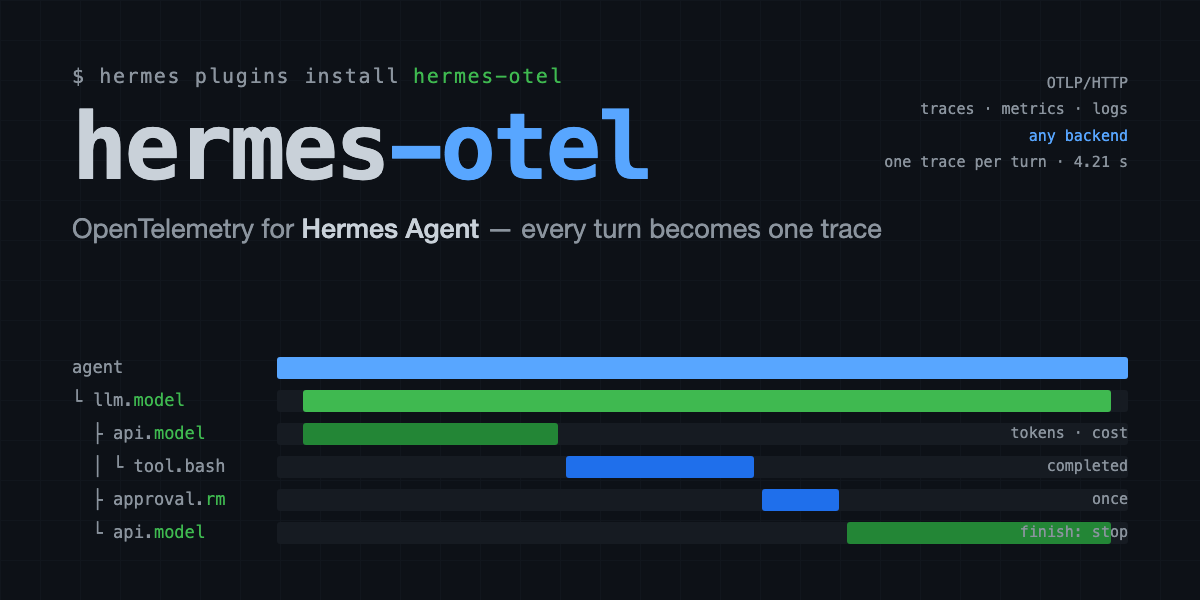





OpenTelemetry plugin for Hermes Agent.
Every Hermes turn — model calls, API requests, tool calls, skill loads, approvals, delegated sub-agents — becomes one OTel trace,
with token, cost and latency metrics and (optionally) logs and structured events, exported to any OTLP backend over HTTP or gRPC.
Documentation · Quickstart · Backends · Configuration · Reference · Changelog
What a turn looks like
agent / cron                          ← the turn (root); turn summary at the end
├── skill.{name}                      ← a loaded skill; spans load → turn end
└── llm.{model}                       ← one run_conversation
    ├── api.{model}                   ← one HTTP round-trip; tokens, cost, finish reason
    ├── tool.{name}                   ← each tool call; args, result, outcome
    ├── approval.{pattern}            ← human / smart-guardian approval wait
    ├── subagent.{role}               ← delegate_task; the child's own trace nests here
    │   └── agent → llm → api, tool …
    └── api.{model}                   ← final response
| Span | Kind | Carries |
|---|---|---|
agent / cron |
AGENT | Session kind and id, completion / interruption status, the per-turn summary (tools, targets, commands, outcomes, skills, API call count, final status) |
skill.{name} |
CHAIN | A skill that loaded successfully — name, source (skill_view / path read), path; open until the turn ends |
llm.{model} |
LLM | Model, provider, user message (input), assistant response (output) |
api.{model} |
LLM | Token counts in both conventions (incl. cache and reasoning buckets), duration, finish reason, request parameters. On failure: ERROR + exception + retry metadata. hermes.query_source says whether the call is the agent loop's own (main), a delegated child's (subagent) or one Hermes made on the agent's behalf (auxiliary: titling, compression, Mixture-of-Agents references and aggregator, vision, …), the last tagged with hermes.auxiliary.task |
tool.{name} |
TOOL | Args, result, hermes.tool.outcome (completed / error / timeout / blocked / cancelled), inferred target / command, hermes.tool.git_commit on a successful git commit (also counted as hermes.commit.count and a commit event), CPU/GPU utilization with host metrics |
approval.{pattern} |
CHAIN | Decision wait time, choice (once / session / always / deny / timeout / smart_approve / smart_deny / smart_escalate), who decided |
subagent.{role} |
AGENT | Role, goal, status, duration, summary, the child's model and what its whole subtree cost; the child run is nested so a multi-agent run is one connected trace |
Running several agents (delegated children, kanban workers on other profiles and models, a swarm, Mixture-of-Agents, cron)? Observing a fleet shows what each looks like in a backend and how to ask what each one cost. A kanban card's run is one trace from the dispatcher's claim through the worker's turn.
Attributes are emitted in both conventions — OpenInference (llm.*, input.value) for Phoenix and OTel GenAI (gen_ai.*) for Langfuse, Weave and generic dashboards — so no backend needs custom mapping. Full lists: span attributes · metrics · hooks.
Backends
Tested with: Phoenix · Langfuse · LangSmith · SigNoz · Jaeger · Zipkin · GreptimeDB · ClickStack · VictoriaMetrics family · Aspire Dashboard · Gigapipe · Agenta · Grafana Tempo · Grafana LGTM · Uptrace · OpenObserve · Parseable · Honeycomb · W&B Weave · Elastic · OpenLIT · MLflow · Comet Opik · Laminar · LangWatch · Latitude.
Any other OTLP endpoint works as type: otlp. It sends HTTP/protobuf by default; set protocol: grpc for gRPC. Both transports support TLS and client certificates (mTLS); see gRPC and TLS. You can send to several backends at once, and each gets its own export queue.
Not every backend takes every signal. Phoenix, Langfuse, LangSmith, Jaeger, Zipkin, Tempo, W&B Weave, MLflow, Opik, Latitude and Agenta take traces only; Laminar takes traces and logs; the rest take traces, metrics and logs. The backends overview has the full table. Every self-hostable backend, plus the candidates tracked in #232, has a ready-made Compose stack under docker-compose/, one folder per backend; docker-compose/README.md has the comparison table and the port map.
Install
hermes plugins install hermes_otel        # from the Hermes plugin catalog
hermes plugins enable hermes_otel         # the manifest name; installing does not enable
Hermes 0.21+ installs the plugin's Python dependencies (the OTel API, SDK, and HTTP/gRPC exporters) into its own virtualenv automatically and re-applies them after every hermes update. Restart the gateway afterwards if one is running. hermes plugins update hermes_otel moves a catalog install to the newest reviewed commit.
What leaves your machine. Span data goes only to the OTLP backends you configure. By default (content_capture: full) that includes the complete prompt and response of every model call, unclipped, plus previews of tool arguments and output clipped to 1200 characters. With none configured the plugin keeps a local SQLite store under $HERMES_HOME for the dashboard and sends nothing. content_capture: preview keeps only the clipped previews and content_capture: off drops content entirely while keeping the structure; see Conversation capture and Privacy mode. The dashboard's Settings tab shows every setting in force, where each came from (file, environment variable or default) and the config file itself.
To run the newest code before it reaches the catalog pin, install from this repository instead (same plugin, newest main, not catalog-reviewed):
hermes plugins install briancaffey/hermes-otel/hermes_otel --enable
The trailing /hermes_otel is the plugin package inside this repo; Hermes installs just that directory to ~/.hermes/plugins/hermes_otel/. If you installed with --no-deps, set security.allow_lazy_installs: false, or run a Hermes older than 0.21, install the dependencies yourself: <hermes venv>/bin/pip install -r ~/.hermes/plugins/hermes_otel/requirements.txt. Details, upgrades and troubleshooting: Installation.
Configure
One backend needs nothing but an environment variable, e.g. OTEL_PHOENIX_ENDPOINT=http://localhost:6006/v1/traces. For anything more, create ~/.hermes/hermes_otel.yaml:
project_name: hermes-agent
backends:
  - type: phoenix
    endpoint: http://localhost:6006/v1/traces          # traces
  - type: lgtm
    endpoint: http://localhost:4318/v1/traces          # traces + metrics + logs
    metrics: true
  - type: honeycomb
    api_key: ${HONEYCOMB_API_KEY}                      # ${VAR} is expanded at load
capture_logs: true
Each Hermes profile has its own install, settings and telemetry; a multiplexed gateway traces every profile it serves under its own name (profiles). config.yaml.example in this repository documents every knob; every scalar knob is also a HERMES_OTEL_* environment variable. See the config schema, the env var reference, and the guides on privacy, short-lived credentials, sampling, logs and events and host & GPU metrics.
Not seeing data? HERMES_OTEL_DEBUG=true writes a per-span log — see debug logging.
Ask the agent
The plugin ships a Hermes skill, hermes_otel:observability, with a terminal query tool the agent runs from the chat. Ask "why was my last turn slow?", "what did this session cost?" or "how often was the deployer skill loaded this week?" and it lists turns, draws one as the span tree above, totals tokens and cost per model, tool or session, and reads metrics and logs, from the local live store (no backend needed) or from any configured backend with a dashboard adapter.
$ python3 ~/.hermes/plugins/hermes_otel/skills/observability/scripts/otel.py trace last
trace 856433c66e23d0b8a0ef10d9ba2c1c53 · source live · 2026-09-21 23:53:22 UTC · session 20260921_195321_b18e68 · model openai/gpt-4o-mini

agent                             13.22 s  ▇▇▇▇▇▇▇▇▇▇▇▇▇▇▇▇  turn 1 · 2 tools · 3 api calls · 39,919 tok · completed · cli
├── llm.openai/gpt-4o-mini        13.19 s  ▇▇▇▇▇▇▇▇▇▇▇▇▇▇▇   openrouter
│   ├── api.openai/gpt-4o-mini     2.01 s  ▇▇                10,695 → 20 tok · tool_calls · 1 tool calls
│   ├── tool.skill_view             37 ms    ▇               completed
│   ├── api.openai/gpt-4o-mini     2.67 s    ▇▇▇             13,810 → 254 tok · 10,624 cached · tool_calls · 3 tool calls
│   ├── tool.terminal              3.81 s        ▇▇▇▇        completed · python3 /private/tmp/claude-501/-Users-brian-gi…
│   ├── tool.terminal              869 ms            ▇       completed · python3 /private/tmp/claude-501/-Users-brian-gi…
│   ├── tool.terminal              315 ms             ▇      completed · python3 /private/tmp/claude-501/-Users-brian-gi…
│   └── api.openai/gpt-4o-mini     3.09 s              ▇▇▇   14,832 → 308 tok · 13,952 cached · stop
└── skill.observability           10.97 s    ▇▇▇▇▇▇▇▇▇▇▇▇▇   skill_view · completed
── 10 spans · 13.22 s · 39,919 tokens
The commands are status, traces, trace, span, sessions, stats, metrics, logs, read-only sql and mcp-config. Most take --json, a time window (--since, --until) and --source <backend>; see The observability skill. Traces on Jaeger or Tempo can also be searched from Claude Code, Cursor or Hermes itself through Traceloop's opentelemetry-mcp server: Query your traces over MCP.
How it works
Hermes fires lifecycle hooks; the plugin maps them onto spans, metrics and logs through one TracerProvider fanned out to every configured backend, and never blocks the agent: span end is a non-blocking enqueue, exporters run on their own threads, hooks fail open. The turn summary, tool identity inference, orphan sweep and batch export are described under Architecture; known gaps under Limitations. Linking MCP-server spans into the agent's trace is implemented on the plugin side but waits on Hermes, see MCP trace propagation.
How this relates to Hermes' built-in telemetry
Hermes ships two observability surfaces of its own. hermes-otel is the third, run-level one, and runs alongside both (core's exporter builds private provider objects and never touches the global tracer provider this plugin installs).
| Hermes gateway monitoring (core) | Bundled Langfuse plugin | hermes-otel | |
|---|---|---|---|
| Scope | Gateway and cron health, content-free by design: no prompts, tool calls, tokens or per-run traces | Per-run traces | Per-run traces (session → LLM → API → tool → sub-agent → approval), GenAI/OpenInference attributes, metrics and logs |
| Backends | Any OTLP receiver (monitoring.export.otlp) |
Langfuse only | 26 backend types plus generic OTLP, fanned out in parallel |
| Coexists with hermes-otel | Yes | Yes |
Docs for the core surfaces: Gateway Monitoring and the plugins/observability/langfuse directory in hermes-agent.
Repository layout
| Path | Role |
|---|---|
hermes_otel/ |
The plugin — the only directory Hermes installs (runtime modules, plugin.yaml, the bundled skill, the dashboard bundle) |
website/ |
The Docusaurus docs site |
tests/ |
Unit, integration and the credential-free e2e_ci/ tier run in CI; e2e/ and smoke/ need real backends |
docker-compose/ |
Backend stacks for local development |
dashboard-ui/ |
TSX sources for the dashboard tab; npm run build writes into hermes_otel/dashboard/dist/ |
scripts/ |
Tools CI runs (the plugin security scanner, the docs and vocabulary generators, the coverage floors, the catalog-entry renderer) and live-check harnesses (scenarios/, dashboard_verify/, kanban_demo/, refactor_check/) |
docs/ |
Assets fetched from outside the repo at a pinned commit: the plugin-catalog banner and its HTML source (make banner re-renders it) |
marketing/, archive/ |
Launch video and article; historical design notes |
Contributing
See CONTRIBUTING.md — the exact CI gate to run locally, the hook / span conventions, and how docs count as acceptance criteria. Releases are cut by release-please from conventional commits (releasing).
License
Apache-2.0 — see LICENSE.