apelabs-dev/hermes-mock-review
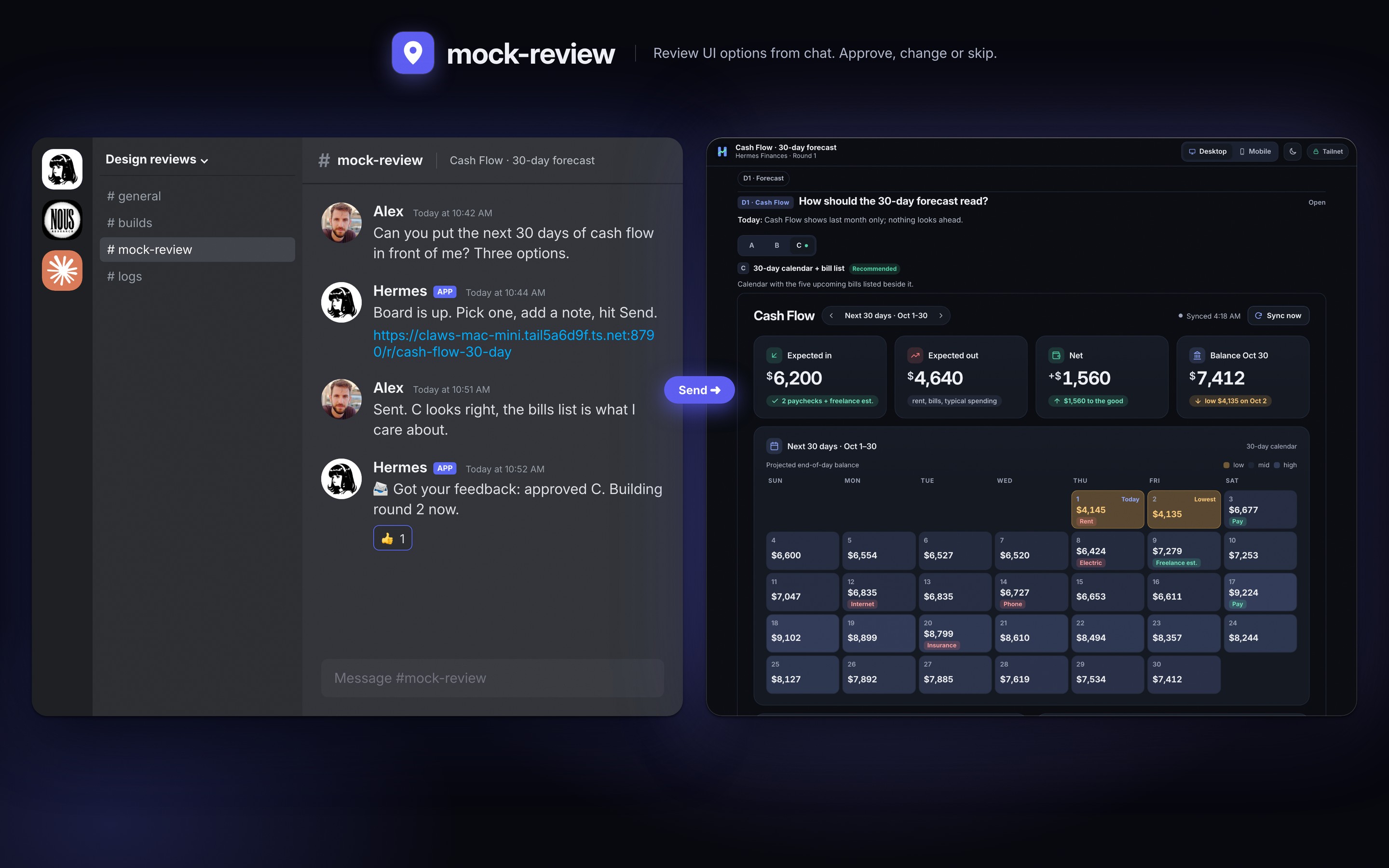
Review boards for UI mockups, as a Hermes plugin: mark decisions, pin comments, press Send, and your agent wakes up with the feedback.
mock-review is a Hermes plugin for reviewing UI and design options through shareable review boards. Reviewers can approve, request changes, or skip decisions, add notes and pins to mockups, then send feedback that wakes the agent in the originating chat.
- Boards show mocks at desktop, tablet, and phone widths.
- Supports local, Tailscale, and here.now hosting.
- Includes CLI commands and agent tools for review rounds.
full readme from github
mock-review
mock-review is a Hermes plugin for reviewing UI and design options. Your agent builds a decision round, the plugin serves it as a review board, and you open the link, mark each decision Approve, Change or Skip, add notes, drop pins on the mocks and press Send. Send wakes the agent in the chat the review came from, with your marks attached. Boards render inline mocks at desktop, tablet and phone widths, in light and dark, and wear a per-project design profile.
Install
Requires Hermes 0.22.0 or newer and Python 3.9 or newer. The plugin has no Python dependencies.
Once the plugin is in the Hermes catalog:
hermes plugins install mock-review
Until then, install it from GitHub:
hermes plugins install apelabs-dev/hermes-mock-review
Enable it if the installer did not: hermes plugins enable mock-review.
Quickstart
hermes mockreview setup
The wizard checks your Hermes version, works out which chat platform to wake you in, enables the webhook platform if you
agree, creates the signing secret, adds a wake route and a notice route for that platform, picks the hosting mode, turns on
autostart, validates the plugin and creates a test review. Add --dry-run to see the plan without changing anything, or
--yes to accept the defaults without questions.
Which chat platform: setup reads the platforms in the Hermes config. The webhook ingress, the Microsoft Graph ingress, the
API server and the local CLI are not chats, so they never count. With one chat platform configured, setup uses it and says
so. With several, it asks (Enter means all of them); under --yes or --dry-run it stops and asks you to choose with
--origin-platform NAME (repeatable). With none, it stops the same way. Either stop happens before anything is changed.
An explicit --origin-platform is always used as given.
The first run usually ends with the test review marked pending (board not running): the review is saved and loads by
itself once the board runs, and setup prints no link until a board answers. The last lines of the output start with
next: and say what to do for your setup. In short:
- Start the board. Inside the gateway: if it is running, restart it (
hermes gateway restart, or stop and run again a gateway you started withhermes gateway run); if it is stopped, start it (hermes gateway run, orhermes gateway startfor the installed service). Wake-ups need the gateway either way. To run nothing inside the gateway, runhermes mockreview servein a terminal instead. - Optional: run
hermes mockreview setupagain. It is safe to repeat: it reuses the secret and routes, notices the board that is already running, closes the earlier test review, and creates a new one whoseboard url:you can open. - Ask your agent for a design review. It calls
mock_review_createand posts the link. This is the real test of the wake-up: press Send on the board and the agent answers in the chat.
Let the woken session build (opt-in)
Hermes runs the session Send wakes with its safe webhook tools only, so by default that session replies "Round N
feedback is saved; the build continues in this thread's chat session." and the chat's own session builds the round. To
let the woken session build right away, set the toolsets, re-run setup and add the line it prints by hand. Include mock-review so it can call the
mock_review tools; the list replaces Hermes's webhook default rather than adding to it:
hermes config set plugins.entries.mock-review.settings.wake_toolsets "mock-review,terminal,file"
hermes mockreview setup
Setup never edits Hermes's route file: it prints the "toolsets" line to add to the wake route in
webhook_subscriptions.json (Hermes keeps this a manual step so an agent cannot grant itself tools). Each setup run
re-subscribes the route and drops the key, so add it again afterwards. It refuses while a board's Send button would be ungated (a here.now board with its password off, or
the server listening beyond loopback), because feedback typed there would reach those tools. Read security first.
Try a board without an agent
With a board running (step 1), create a review from a terminal. examples/demo-variants holds three full-page variants of
one pricing page; this one opens as a live prototype:
EXAMPLES="${HERMES_HOME:-$HOME/.hermes}/plugins/mock-review/examples/demo-variants"   # from a checkout: "$PWD/examples/demo-variants"
hermes mockreview create --title "Pricing page" --platform local --chat-id demo --no-wake --allow-live-demo \
  --prototype "$EXAMPLES/a-calm-editorial/index.html"
It prints the review's url. --no-wake makes it a board nobody is woken by, so no signing secret or route is needed.
A live prototype opens in Use it mode, so clicks work the page. To leave a comment, switch the header to Pin and
tap the spot; after each pin the board goes back to Use it.
Agents write decision rounds instead; see docs/decisions-format.md.
Hosting modes
A review is hosted in one of three ways. Set the default with default_host, or let the agent ask you.
local(the default): the board is served from this computer. With the default bind address the link opens on this computer only. Settinghostto0.0.0.0makes local links open on other devices on your network, with no login.tailnet: the board stays on loopback and you expose it withtailscale serve. The link is your Tailscale address, so only your tailnet can open it.setupoffers this when Tailscale is running, andsetup --hosting tailnetselects it.herenow: the board is published on here.now with a password gate by default; feedback comes back through its Site Data. This needs the official here-now Hermes skill and aHERENOW_API_KEY. Create/add-round/publish return apasswordbeside the URL: send both to the reviewer. Use--no-passwordon create only for an intentionally public board. Change an open board withhermes mockreview password <id> on|offor/mockreview password <id> <on|off>. A prototype round on a password-gated here.now board is bundled into one self-contained HTML file (local CSS, scripts, images and fonts inlined; a missing or unsupported reference fails the call), then published and loaded in a real Chrome, Chromium or Edge behind its password inside the sandboxed iframe; failed requests or an unstyled page fail the publish and the link and password are withheld. The sandboxed frame has an opaque origin, so theSameSite=Laxunlock cookie is not sent with its requests and any file left on the site would 401; fetching the URLs withcurland the cookie proves nothing. SetMOCKREVIEW_BROWSERif the browser is not found. Details in docs/hosting.md.
docs/hosting.md covers each mode step by step.
Platforms
macOS and Linux run everything, including the board inside the gateway process (autostart). On Windows, run the board in
the foreground with hermes mockreview serve. The plugin installs no service files on any platform.
Known issue: here.now publishing runs the official skill's Bash helper. On Windows it requires Git Bash on PATH
with compatible paths, or running Hermes and the plugin inside WSL. Native Windows without Bash cannot publish
here.now reviews; local hosting does not need Bash. See hosting requirements.
Commands and reference
hermes mockreview <command> and the /mockreview slash command (list, open, close, password, settings). The agent uses five
tools: mock_review_create, mock_review_add_round, mock_review_feedback, mock_review_ack and mock_review_list.
- docs/cli.md: every command with its flags
- docs/settings.md: every setting, its default and its environment variable
- docs/decisions-format.md: the
decisions.jsonblocks an agent writes - docs/hosting.md, docs/security.md and docs/troubleshooting.md
Disclosures
What the plugin does that you may want to know before installing it.
Background server. When autostart is on, the plugin starts a board web server on a background thread inside the Hermes
gateway process, plus one worker thread that retries undelivered wake-ups, polls here.now and runs the optional
auto-close and cleanup of old reviews. autostart is off until hermes mockreview setup turns it on. The CLI,
hermes plugins validate and Kanban workers never start a server. hermes mockreview serve runs the same server in the
foreground instead.
Bind address and port. The server listens on 127.0.0.1:8790 by default (settings host and port). If you set host
to 0.0.0.0, every device that can reach your computer on that port can open every review and send feedback. There is no
login. Do this only on a network you trust. Setup prints this warning before it makes the change.
Outbound network calls:
- The Hermes webhook on
http://localhost:8644(settingwebhook_url): a signed POST when you press Send, to wake your agent. It stays on your computer. - The same local webhook again, on a second route (
<webhook_route>-<platform>-notice): up to two more signed POSTs, still loopback only. One right after the wake-up is accepted (an instant "got it, working on round N" in the origin chat, also mirrored into that chat's session), and one later, only when a sent round gets no new round withinstale_after_minutes(orstale_after_read_minutesafter the agent read it), to say the agent may have stalled. No ping for a round with nothing left to build, one the agent acknowledged, or a closed review. Both carry the review title and counts, never your notes, and use the same signing secret as the wake-up. - here.now (
https://here.now/api/v1), only for reviews you host withherenow: the plugin publishes the board and reads submitted feedback using your key. It publishes through the official here-now skill'spublish.sh. - Nothing else. There is no telemetry, analytics or update check.
Credentials. The plugin reads two secrets through Hermes's secret scope and keeps none of its own:
MOCKREVIEW_WEBHOOK_SECRET (signs the wake-up request; setup generates it and stores it with hermes config set) and
HERENOW_API_KEY (optional, here.now hosting only). Both are declared as optional secrets in plugin.yaml.
Shell commands. bash <here-now skill>/scripts/publish.sh publishes a here.now review, with HERENOW_API_KEY passed in
the child environment. tailscale status --json and tailscale serve status --json find your tailnet address and existing
routes when you use tailnet hosting (on macOS, the app's own binary when the tailscale symlink crashes); they only
read, and setup prints any tailscale serve command for you to run. setup also
runs hermes subcommands: --version, gateway status and config get to read the current state, and config set,
config unset for obsolete settings, webhook subscribe, webhook remove (only for a self-delivering route left by an
older setup, and only after you confirm) and plugins validate to make its changes.
Files. Reviews are stored under $HERMES_HOME/workspace/mock-reviews (setting data_dir). The plugin reads the Hermes
config.yaml through Hermes, or directly for its own settings when it runs outside the gateway.
Development
python -m pytest -q
The suite needs pytest and pyyaml. AGENTS.md describes the layout and the rules a change has to keep.
CHANGELOG.md lists releases.
Releasing
Commits on main drive the version, through .github/workflows/release-please.yml (Release Please, pinned to a commit).
Every push opens or updates one release pull request; merging it bumps the version, prepends the changelog entry, tags
vX.Y.Z and publishes the GitHub release.
fix:andperf:commits cut a patch release,feat:a minor,feat!:or aBREAKING CHANGE:footer a major.docs:,test:,ci:andchore:commits cut no release on their own.- Do not edit the version by hand.
release-please-config.jsonnames the files that carry it:plugin.yamlandmockreview/__init__.py, each markedx-release-please-version, plus.release-please-manifest.json. A test fails when they disagree. - After a release the catalog pin stays manual: a pull request against
NousResearch/hermes-agentthat points its catalog at the new tag. - The action needs one repository setting, once: Settings > Actions > General > Workflow permissions, "Allow GitHub Actions to create and approve pull requests".
License
MIT. See LICENSE.
Safe absolute HTTP(S) links in mock/option HTML open in a new tab with noopener noreferrer. Table cells remain
text, with bare absolute HTTP(S) URLs linked even inside prose or alongside other URLs. Surrounding punctuation
and literal HTML stay text. Relative URLs and other link protocols are not linked.
See password hosting and recovery and security.